

- Event
- Cementing Our Future: Unlocking Ontario’s Next Era of Prosperity Through Transportation Infrastructure, hosted by the Empire Club of Canada
- Venue
- Four Seasons Hotel Toronto, Toronto, Ontario
- Date
- Tuesday, November 10, 2026
- Speakers
- The Honourable Prabmeet Singh Sarkaria, Ontario’s Minister of Transportation, in conversation with Jordan Bitove, Publisher, Toronto Star
- Host
- Saurabh Popat, Chair of the Board of Directors, Empire Club of Canada
- Partners
- Lead sponsor: Ontario Road Builders’ Association. Reception sponsors included the Insurance Bureau of Canada. Media partner: Toronto Star.
Key takeaways
- The Minister measured success in time: one mother at Mount Dennis gets six hours and ten minutes back with her family every week.
- Gridlock costs Ontario an estimated 56 billion dollars a year.
- The Minister said the Greater Toronto Area alone will have ten tunnel boring machines. The Ontario Line‘s first has reached the future King West Station.
- Highway 413 is a 52-kilometre corridor across Halton, Peel and York.
- Self-driving vehicles are part of Ontario’s long-term thinking, and that will change how risk is shared.
What numbers did the Minister share at the Empire Club?
One commute, before and after
37 minutes back each way. Five days a week, that is 6 hours 10 minutes back with her family, every week.
What did Ontario’s Transportation Minister say at the Empire Club of Canada?
The Honourable Prabmeet Singh Sarkaria did not open the keynote with a budget line. The Minister opened with a mother. At the opening of Mount Dennis station, the Minister met a woman who travels to Union Station for work almost every day. Her commute used to be close to 55 minutes each way. With the new connection, it is 18 minutes. That is 37 minutes back on each trip, and over a five-day week, six hours and ten minutes back for her family.
“Six hours isn’t just a number. It’s being there for the moments that matter: the school pickup, dinner around the table, or simply hearing about your child’s day.”
“This wasn’t a line on a map,” the Minister said. “It was a different quality of life.”
How much does gridlock cost Ontario?
“Gridlock is estimated to cost this province fifty-six billion dollars a year,” the Minister said. The figure comes from a 2024 study by the Canadian Centre for Economic Analysis for the Residential and Civil Construction Alliance of Ontario and the Ontario Road Builders’ Association, which put the cost at 56.4 billion dollars.
The Minister said Ontario is investing 70 billion dollars in transit and another 31 billion dollars over ten years in highways, roads and bridges. “It is not what we spend,” the Minister added. “It is what those investments make possible.”
How big is Ontario’s transit and highway build?
Ten tunnel machines under the Greater Toronto Area
Under Toronto, the Minister said, tunnel boring machines are digging as deep as 40 metres, roughly the height of a 13-storey building. The first machine on the Ontario Line, named Libby, has broken through into the future King West Station. “Here in the GTA alone,” the Minister said, “we will have ten.”
The Ontario Line will add 15.6 kilometres of new subway and put roughly 230,000 more people within walking distance of rapid transit, according to the federal government. The Minister said a trip that takes about 70 minutes today will take less than 30.
Highway 413
The new highway will run 52 kilometres across Halton, Peel and York. Ontario’s 2026 Budget says it could cut travel times by up to 30 minutes a trip and support an average of 6,000 jobs a year during construction.
GO Transit and One Fare
On the Kitchener line, the Minister said weekly GO trips have more than tripled since 2018. The Minister said riders have made more than 100 million free transfers under One Fare, and the province says a regular commuter can save up to 1,600 dollars a year.
What did the fireside chat with Jordan Bitove cover?
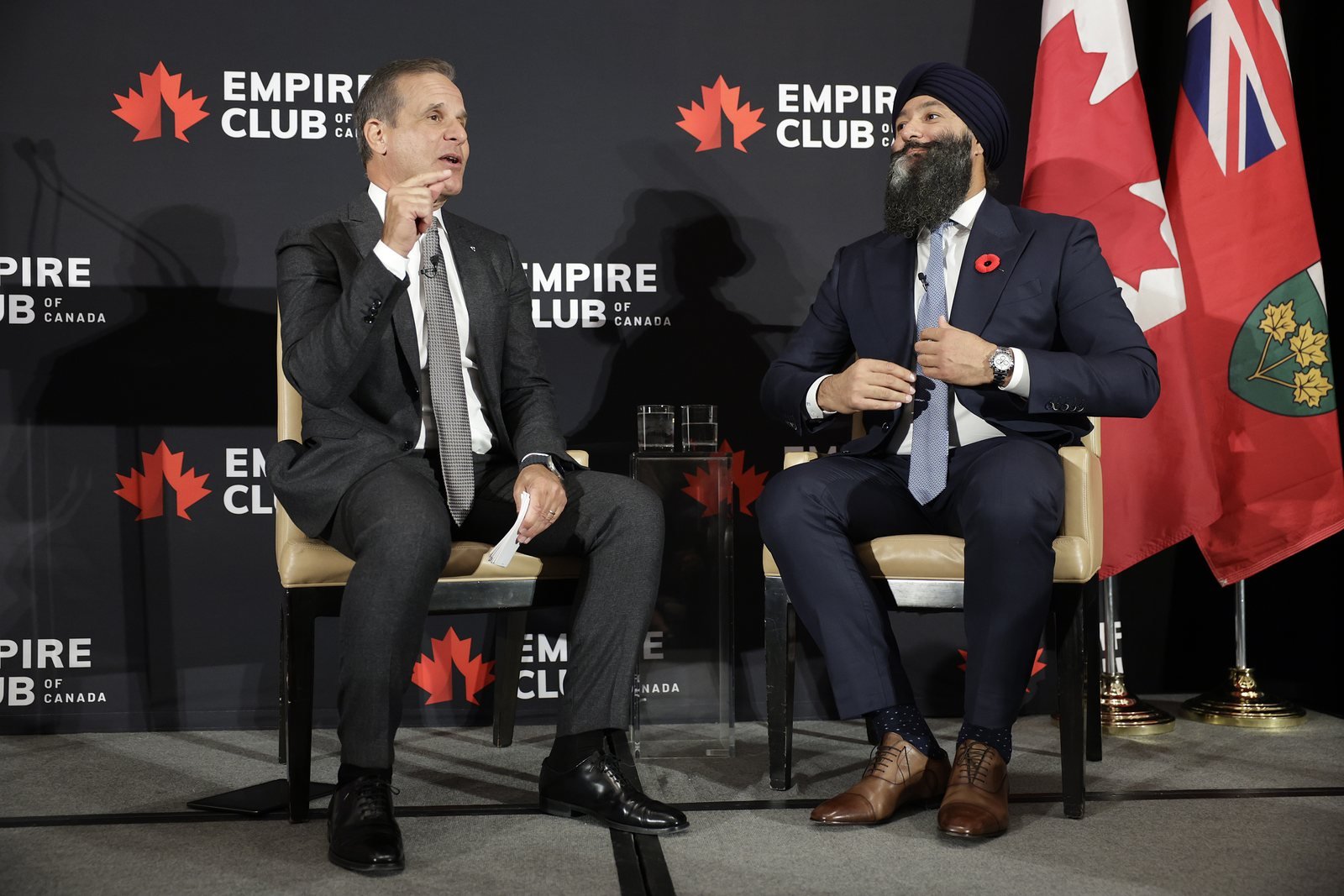
Mr. Bitove asked whether Ontario’s transportation is keeping pace with its economic goals. The Minister said big projects have to be planned past a four-year election cycle, and was frank about the years of construction ahead: “a little bit of pain, a little bit of gain.”
On cost, the Minister spoke about the risk of digging. “You have no idea what you’re going to encounter when you dig into the ground,” the Minister said. A surprise underground can mean a delay of days or of a year. “But the cost of not building is far greater.”
What does Ontario’s infrastructure plan mean for insurance?
The Insurance Bureau of Canada was among the event’s reception sponsors, and the themes in the room touch insurance directly. This is our view.
Road risk moves with the network. New highways, faster routes and more transit riders change where people drive, how far and how often.
Building risk is real risk. The Minister’s point about the unknowns underground is the daily work of construction and project insurance.
Self-driving cars are in the plan. Answering an audience question about self-driving vehicles and AI, the Minister said, “self-driving vehicles are the future. We want to be a part of that.” The Minister also spoke about AI in traffic modelling, traffic lights and transit.
When machines start making decisions on the road, the question of who is responsible changes with them. As ZERO LEGACY puts it, “in the autonomous enterprise, accountability is an architectural property” (page 100).
Harpreet Singh attended the Empire Club of Canada event as media for Zero Legacy Press.