
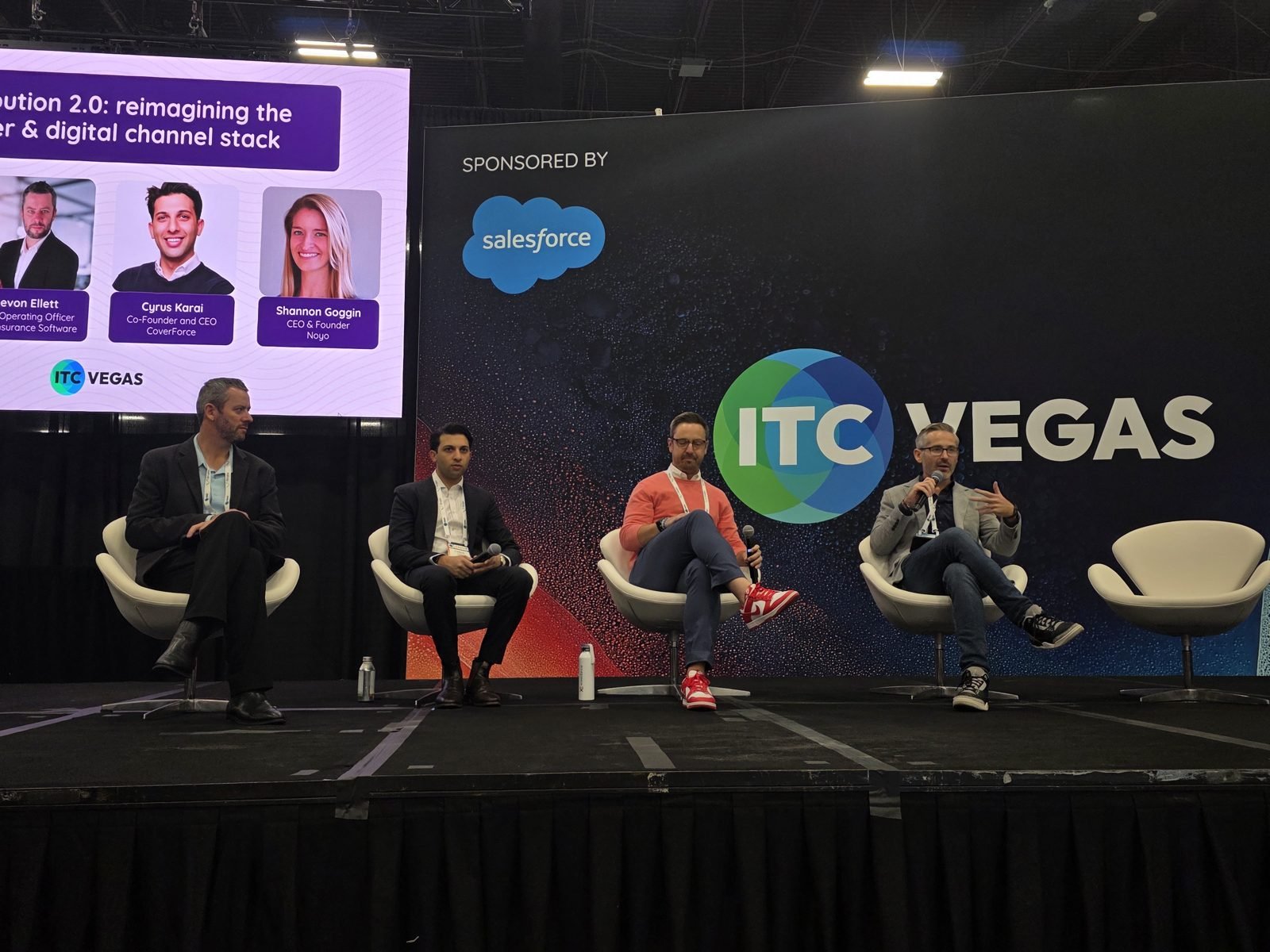
- Event
- ITC Vegas 2026 (InsureTech Connect), Innovation Through Growth Stage, sponsored by Salesforce
- Venue
- Mandalay Bay, Las Vegas, Nevada
- Date
- Thursday, October 1, 2026
- Session
- Distribution 2.0: reimagining the broker and digital channel stack
- Speakers
- Rick Zullo, General Partner and Co-Founder, Equal Ventures (moderator); Devon Ellett, Chief Operating Officer, INTX Insurance Software; Cyrus Karai, Co-Founder and CEO, CoverForce; Ryan Sachtjen, Co-Founder and CEO, ThreeFlow (in place of Shannon Goggin, CEO and Founder, Noyo). Opening remarks: Jerome Simmons, Director of Insurance Industry Marketing, Salesforce
Key takeaways
- Noyo is joining ThreeFlow. ThreeFlow CEO Ryan Sachtjen announced on stage that the deal had closed about an hour earlier.
- Salesforce’s Jerome Simmons pointed to a TD Bank study showing 77 percent of Gen Z and Millennials now turn to AI for financial advice. Insurers have to show up in those AI conversations “in a trusted way.”
- He also said producers spend about 41 percent of their time on admin work that has nothing to do with selling, which is where AI should help first.
- The panel agreed AI will change the broker’s role, not remove it. The value moves from typing in data to being the trusted adviser.
- INTX’s Devon Ellett named the real bottleneck: carrier appetite still sits in PDFs, while broker submissions arrive by email.
What did Salesforce ask the room to think about?
Jerome Simmons, Director of Insurance Industry Marketing at Salesforce, which sponsored the stage, opened the morning with two questions. Much of the AI talk at conferences, he said, has been inward-looking: better producers, faster claims, lower cost to serve. But customers now have many of the same AI tools insurers do.
He cited a recent TD Bank study finding that 77 percent of Gen Z and Millennials go to AI for financial advice, just as a large transfer of wealth to those generations gets under way. His first question: how does the industry show up in those AI conversations “in a trusted way”? His second: how do we take the admin burden off producers, who he said spend about 41 percent of their time on tasks that have nothing to do with selling or building relationships?
What news broke on stage?
The panel opened with a surprise. Ryan Sachtjen, co-founder and CEO of ThreeFlow, took the seat listed for Noyo founder and CEO Shannon Goggin, and explained why. “Noyo and ThreeFlow will be coming together as one company,” he said, with the deal closed about an hour before the session. Goggin, he said, was talking to customers at that very moment.
ThreeFlow builds a benefits placement system for brokers, carriers and employers. With Noyo joining, Sachtjen said, the combined company will also serve benefits administrators and payroll companies.
Who else was on the panel?
Cyrus Karai, co-founder and CEO of CoverForce, described his company as the connectivity layer between wholesalers, brokers and their preferred carriers, with about 60 commercial insurance products. He said CoverForce powers large distribution firms including Amwins and Brown & Brown, and added, “We processed about 1.2 billion dollars of underwriting last year.”
Devon Ellett, COO and a co-founder of INTX Insurance Software, described an end-to-end insurance platform with a strong focus on reinsurance, handling assumed and ceded business alongside the full policy life cycle. He named the problem distribution has to fix: “At the moment, your carrier’s appetite is sitting in a PDF.” Broker submissions arrive by email, and broker portals often do not tie back to anything else. Joining those pieces up, he said, is what will change distribution.
Will AI cut out the broker?
Moderator Rick Zullo of Equal Ventures went straight to the question every distribution panel faces this year: will AI-driven tools let customers skip the broker altogether?
Ellett said no. AI will change the process and make it smoother, but brokers still do much of the risk selection. In a real conversation with a client, they pick up information that never makes it onto an application form. “There’s always going to be a place for the broker,” he said.
Karai drew a line between commercial and personal lines. Brokers tell him their value will always be “the consultative partner in the relationship, not the data input provider,” and what customers want is to trust that their business is properly covered when a loss happens. He compared it to law, where people now ask AI first but still want a professional to sign off. For someone just buying car or home insurance, he suggested, the broker’s role as go-between may matter less. On the commercial side, brokers are looking for ways to take themselves out of the data transfer while keeping the advice.
Zullo added a warning about “lazy margin”: if AI tools let customers switch the moment a cheaper price appears, some players will chase the lowest price at the expense of proper cover.
Why it matters for insurers
For carriers and MGAs, the message was practical. If brokers are moving from data entry to advice, the carriers that win will be the ones whose appetite, rules and products can be read and acted on by machines, not buried in PDFs. And if customers are asking AI for advice, insurers need to be present, and trusted, in those answers.
ZERO LEGACY, from Zero Legacy Press, makes a similar case: the work worth automating is the paperwork, so that people can spend their time on judgment and relationships. Read about the book
Who spoke
- Rick Zullo, General Partner and Co-Founder, Equal Ventures (moderator)
- Devon Ellett, Chief Operating Officer, INTX Insurance Software
- Cyrus Karai, Co-Founder and CEO, CoverForce
- Ryan Sachtjen, Co-Founder and CEO, ThreeFlow
- Jerome Simmons, Director of Insurance Industry Marketing, Salesforce (opening remarks)