
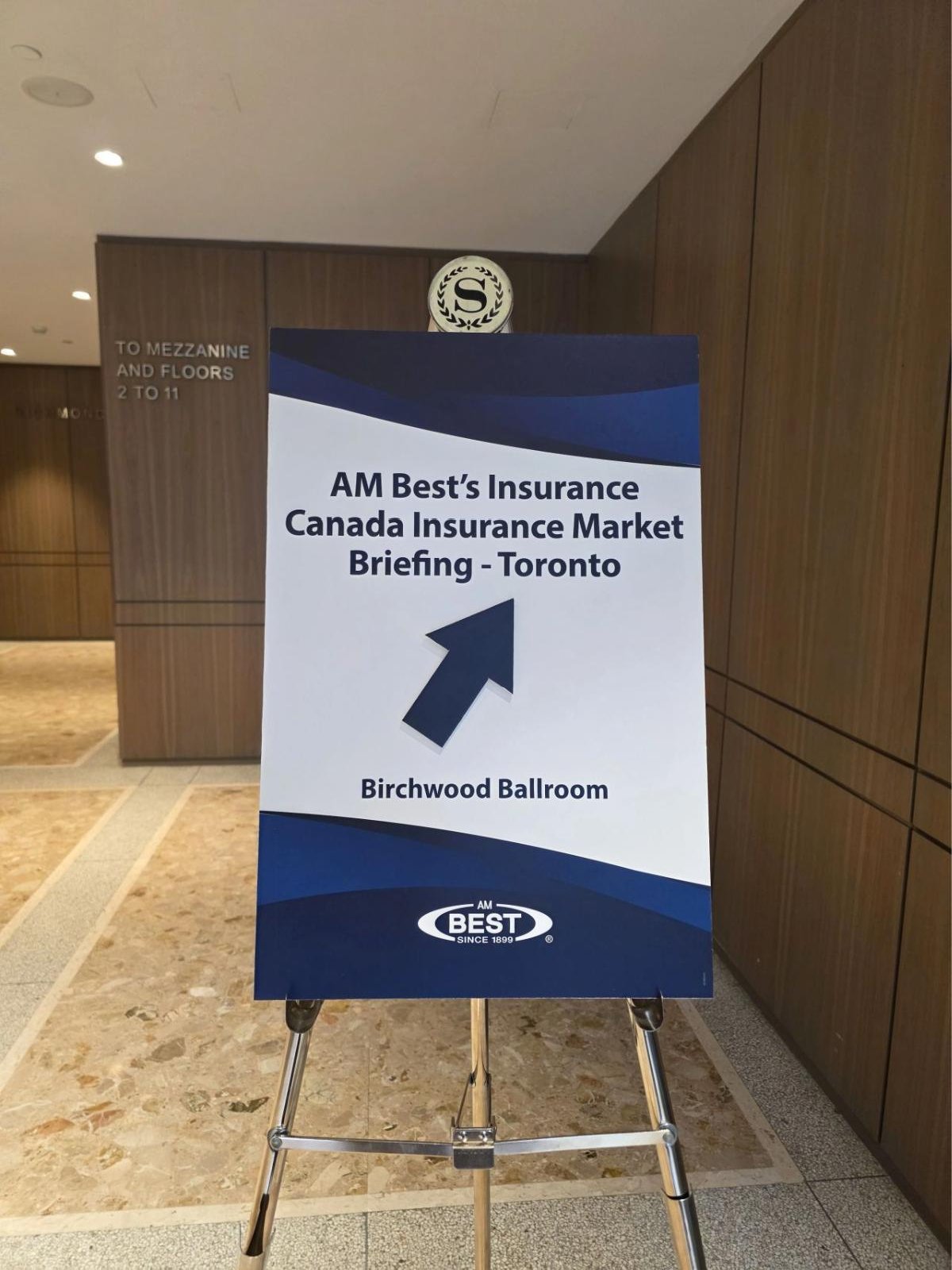
- Event
- AM Best’s Canada Insurance Market Briefing, Toronto
- Venue
- Sheraton Centre Toronto Hotel, Birchwood Ballroom
- When
- Wednesday, September 23, 2026, morning
- Host
- AM Best
Key takeaways
- AM Best kept a stable outlook on both Canadian property and casualty insurers and Canadian life and annuity insurers.
- Canadian P&C insurers had a strong 2025. AM Best’s analysts said industry equity rose to about 70.8 billion dollars and the combined ratio improved by about five points.
- Catastrophes remain the big worry. Three severe storm events in 2026 had already passed 1.8 billion dollars in insured losses, so 2026 is likely to cost more than 2025.
- Canada’s MGA market has about 120 firms and about 4 billion dollars in premium. That is roughly 10 to 15 percent of commercial lines, and it is growing.
- CAMGA is calling for a national standard for MGA oversight across the provinces, and the panel agreed AI and better data will decide which MGAs win.
How is the Canadian economy shaping insurance?
Ann Modica, a director at AM Best who covers country risk, opened with the economy. Exports to the United States have fallen by about 30 billion dollars in a year, she said. Exports to other markets, especially the United Kingdom, China and the European Union, are rising. Canada is diversifying, but the United States is still by far its largest market, so that shift will take time.
The labour market has softened gradually rather than suddenly. Unemployment moved back toward the mid-six percent range, and wage growth slowed from about 3.9 percent in 2024 to about 2.8 percent in 2026. Inflation is above the Bank of Canada‘s two percent target again. This time it comes mainly from energy prices and tariffs, which interest rates cannot fix. Her view was that the Bank would likely hold its rate at 2.25 percent for the rest of the year.
How are Canada’s life and annuity insurers doing?
Kevin Varvaro, a senior financial analyst at AM Best who covers Canada’s largest life insurers, said AM Best keeps a stable outlook on the sector. Capital is strong, earnings are steady, and companies spread across Asia, Europe and the United States have that diversification to lean on. Digitization is starting to pay off, with expenses staying flat while revenue grows. In the past twelve months, all three rating changes for Canadian life insurers were positive.
He also named what he is watching. Trade tensions and conflict in the Middle East are pushing up fuel costs. As insurers move upmarket, a coverage gap is opening at the lower end of the mass affluent market. Cyber and AI risks are changing fast, and private credit is growing in insurers’ portfolios. AM Best has started asking companies to break down their private credit holdings so it can see the risks more clearly.
How did Canada’s property and casualty insurers perform in 2025?
Alan Murray, a director at AM Best, and Cristian Sieira, a senior financial analyst, presented the P&C view. AM Best maintains a stable outlook on Canada’s property and casualty sector, supported by strong capital, profitable underwriting and solid investment returns.
Stronger capital
Industry equity grew to about 70.8 billion dollars in 2025 from 65.5 billion, about eight percent growth, and has nearly doubled since 2021.
Better underwriting
Underwriting income rose to about 11.2 billion dollars from 7.4 billion, lifting net income to about 9.5 billion. The combined ratio improved by about five points.
Upgrades outpaced downgrades
Among 97 rated Canadian P&C entities, there were 14 upgrades and only two downgrades in 2025. More than 90 percent carry a stable outlook.
Sieira walked through the year’s catastrophes. The Ontario and Quebec ice storm was the largest 2025 event, at about 466 million dollars. Wildfires came next at about 300 million, then prairie storms at about 235 million. The range of perils, from ice to fire to hail, shows how broad catastrophe exposure has become across the country. In 2026, severe convective storms in Saskatchewan and Manitoba alone led to more than 900 million dollars in insured losses.
Personal property had its best results since 2021, but it is still a hard market. Commercial property posted its best loss ratio in ten years, and brokers are starting to see softer pricing for well-performing risks. On auto, the analysts pointed to two changes. Alberta moves to a new auto insurance system in 2027. Ontario’s reform from July 1, 2026 made several accident benefits optional, while medical, rehabilitation and attendant care stay mandatory.
Consolidation continues. The top ten insurers hold about 60 percent of the market, and Definity’s 3.3 billion dollar acquisition of Travelers Canada is the biggest recent example.
Is AI liability the next cyber?
An audience member asked about AI-related liability. Sieira said it is still an emerging area in Canada, with regulators stepping up their oversight of AI software. Murray described the pattern the industry usually follows when a new risk appears. First comes the question of whether an existing policy already covers it. Then the industry decides whether to add sublimits, or, as it did with cyber, to create a separate coverage with its own limits.
Cover for AI failure sits today where cyber sat in 2014. It is hidden inside professional liability and E&O portfolios, not yet priced, and close to becoming its own line.
ZERO LEGACY, Chapter IV, page 109
Why are MGAs growing so fast in Canada?
Sridhar Manyem, a senior director at AM Best, moderated the panel on managing general agents. He said AM Best estimates the MGA premium reported in United States filings grew from about 50 billion dollars in 2020 to more than 120 billion today. Handing an MGA the authority to write business is a bit like handing over your credit card, he joked. That is why AM Best created its performance assessment for delegated underwriting authority enterprises. It judges how well an MGA can carry out an insurer’s mandate.
Brett Boadway, executive director of the Canadian Association of Managing General Agents (CAMGA), shared CAMGA’s estimates for Canada. There are about 120 MGA firms, with about 4 billion dollars in gross written premium. That is 10 to 15 percent of all commercial lines business. In the United Kingdom, MGAs now write about a third of commercial lines. Her prediction was that Canada is on the same path.
Matt Wolfe, president and CEO of Aon Reinsurance Solutions Canada, explained the math. An MGA adds a layer of cost, so it has to deliver better than average loss ratios to be worth it. He sees large broker-owned MGAs on the rise. He also sees more capital from pension funds and hedge funds, which now makes up a meaningful share of global reinsurance capital and is moving closer to the original risk.
Paul Jackson, CEO of Zurich Canada, said carriers now think of MGAs as part of their whole distribution mix, not just a niche add-on. MGAs bring speed, local presence and deep expertise. Brady DeSantis, vice president of underwriting solutions at Navacord, added that an MGA can place smaller bets on new technology or new regions, and can have people on the ground in places like Victoria, St. John’s and Moose Jaw where a large carrier cannot open an office.
How are MGAs regulated in Canada, and what should change?
Boadway pushed back on the idea that MGAs are not regulated. They are, she said, but the rules differ from province to province. Each sets its own rules on who must register, whether staff need a licence, and whether the firm needs a trust account, a fidelity bond or minimum working capital. In Ontario, MGA licensing is voluntary, although almost all MGAs choose it as a signal of trust.
CAMGA’s answer, set out in its white paper on regulatory standards for P&C MGAs, is a national standard, not a single national regulator. That means common standards for the person who supervises an MGA. It also means the same fidelity, E&O insurance and trust account rules in every province, and one audit module so an MGA can show its evidence once. Jackson supported a level playing field, and noted that insurers and brokers also deal with many different regulators across the country.
What makes a high-quality MGA?
Wolfe said the answer starts with a long-term underwriting mindset. It is easy to chase premium and commission and leave a carrier with poor results. The MGAs still standing in 15 or 20 years will be the ones committed to profitable underwriting for their partners.
Jackson said Zurich’s diligence on MGAs is a steep hill on purpose. It looks at character and credibility as much as hard skills: who the people are, their track record, and above all the quality and consistency of their data. Once that trust is earned, he wants to truly delegate authority rather than repeat the MGA’s work in-house. His advice to MGAs was to think and act like insurers.
Boadway raised a talent point. This summer she reviewed the main textbooks for new brokers and underwriters. MGAs are not mentioned at all, which is a gap in how the industry trains its next generation.
How will AI change the MGA model?
DeSantis said the first practical use is AI that reads incoming submissions, taking data entry off underwriters’ desks and helping them see which deals they are most likely to win. Further out, AI agents may handle parts of underwriting, but only if their decisions can be audited. If carriers and reinsurers cannot see what the agent is doing, they will not sign up.
Jackson was blunt that the industry cannot carry on with manual data exchange and bordereaux, which bring cost and error. Insurers and MGAs will have to invest seriously in AI-based processing. Wolfe added that the cost of that investment may push more consolidation, because smaller insurers and MGAs may struggle to fund it alone.
How does an AM Best rating committee work?
The morning ended with a mock rating committee on a fictional insurer, True North Insurance Group, so the audience could see how AM Best reaches a rating. A committee needs at least six voting members, at least two of them director level or higher, and a simple majority approves a rating action. Members need six months in the ratings division and must be free of conflicts to vote. The lead analyst votes first, the chair votes last, and the chair can break a tie or send a hard case to a corporate rating committee.
Every rating starts with balance sheet strength, anchored by AM Best’s capital adequacy ratio, then moves through operating performance, business profile and enterprise risk management. In the example, the team recommended a positive outlook because underwriting results had improved steadily, not because of investment income alone. Asked where MGA partners fit, the analysts said they mainly show up in the business profile. AM Best also looks at how an MGA’s business has performed when a carrier enters a new region through one.
Why it matters for insurers, brokers and MGAs
The briefing painted a market that is financially strong but facing more frequent catastrophes, tighter competition and fast growth in delegated underwriting. The same theme ran through every session: data quality, clear governance and trust decide who grows.
That matches the advice ZERO LEGACY, from Zero Legacy Press, gives MGAs on page 36: “Write your authority as a versioned, machine-executable file. The guideline is the governance.” And: “Version every change so drift is detectable rather than invisible.” A delegated authority that a carrier, a reinsurer and a rating agency can read and audit is the kind of trust the panel was describing.
Who spoke at the briefing
- Ann Modica, Director, AM Best
- Kevin Varvaro, Senior Financial Analyst, AM Best
- Alan Murray, Director, AM Best
- Cristian Sieira, Senior Financial Analyst, AM Best
- Sridhar Manyem, Senior Director, AM Best (moderator)
- Brett Boadway, Executive Director, CAMGA
- Brady DeSantis, Vice President, Underwriting Solutions, Navacord
- Paul Jackson, CEO, Zurich Canada
- Matt Wolfe, President and CEO, Aon Reinsurance Solutions Canada