
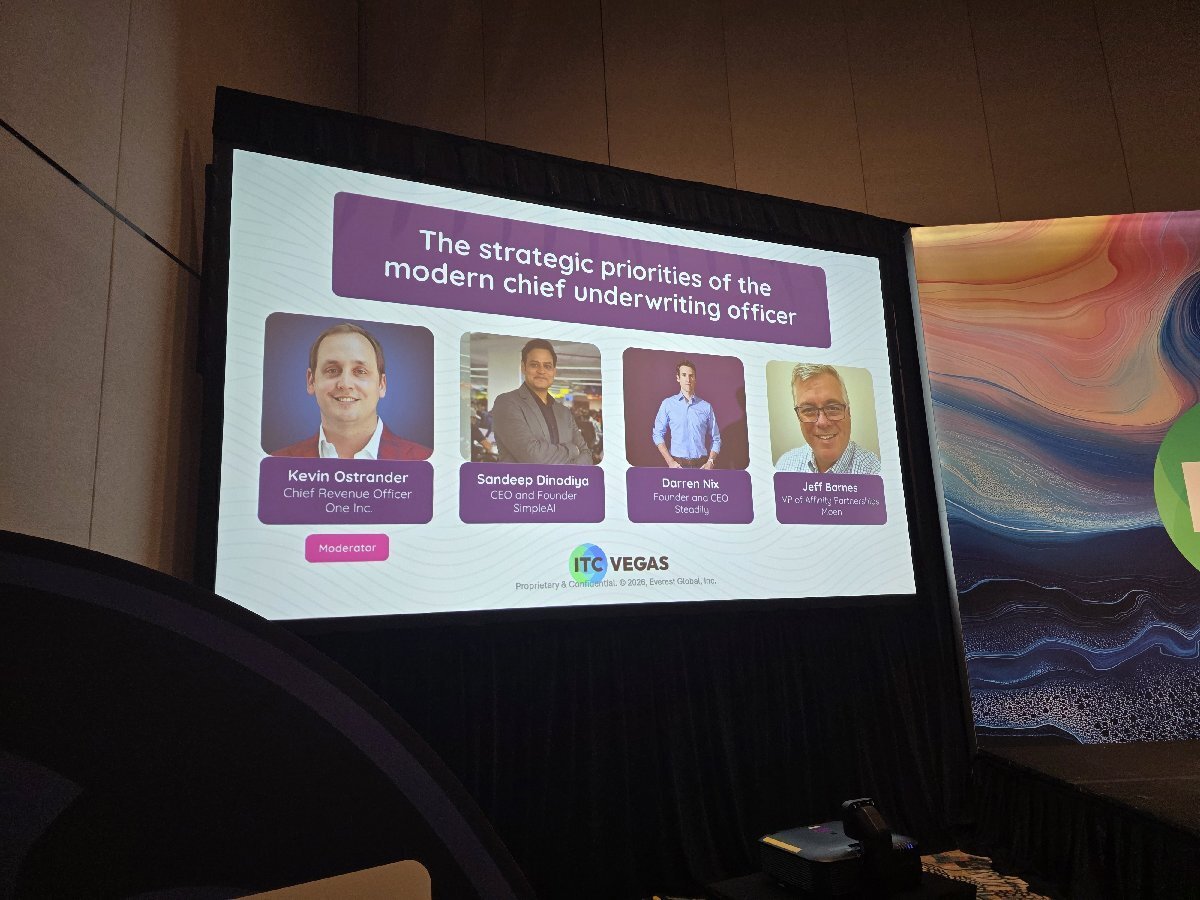
- Session
- The strategic priorities of the modern chief underwriting officer
- Stage
- Underwriting Summit, Mandalay Bay Ballroom J, ITC Vegas 2026, Las Vegas
- When
- Tuesday, September 29, 2026, 1:05 p.m.
- Speakers
- Kevin Ostrander (moderator), One Inc; Sandeep Dinodiya, SimplAI; Darren Nix, Steadily; Jeff Barnes, Moen
Key takeaways
- Darren Nix of Steadily wants his people’s time spent on judgment, and uses AI to cut the hours spent moving data from one system to another.
- Every AI workflow at Steadily keeps a human in the loop. The person who signs is responsible, not the model.
- Jeff Barnes of Moen argued that the small discounts insurers give for home devices could do more good funding prevention.
- Sandeep Dinodiya of SimplAI said the lasting edge is a company’s own data and process knowledge, kept under its own control.
How is the chief underwriting officer’s job changing?
Kevin Ostrander of One Inc, who moderated, laid out how wide the role has become. On top of risk selection, the chief underwriting officer now owns model governance, portfolio analytics and technology investment decisions. When that much gets added, he asked, what comes off the plate?
Darren Nix, founder and CEO of Steadily, said insurers have long had data such as satellite photos of a roof. What was missing was a way to act on it in the time available. Models now make that possible, which raises the harder question of whether you can trust the decision. Jeff Barnes of Moen pointed to the other pressure on the desk: claim costs keep rising, from repairs to legal fees to rebuilds. “Very few things are less expensive now than they were five years ago,” he said.
What should AI take off the underwriter’s plate?
Nix gave the clearest answer of the session. When he shadows an underwriter, a claims adjuster or a sales rep, he looks at how much of the day goes to judgment, the thing they are paid for, and how much goes to what he calls shuffling bytes: moving data between systems, annotating calls and writing up notes. Most of the day, he said, is the second kind. That is where his product and engineering teams point AI. “The judgment, that’s where I want my folks to spend almost all of their time,” he said.
Dinodiya agreed that people should not sit at every step. Put a human at the few critical decision points, he said, and build evaluations so you can see what goes wrong once a system is live.
When a model gets it wrong, who is accountable?
Nix was blunt. Regulators are clear about who owns the decision, so every AI workflow at Steadily has a human in the loop. The system might do almost all of the work and show one page of decisions, with the option to click into any input. The expert still makes the call. He told his whole company the same thing about documents written with AI:
“You put your name on the doc. You’re responsible.”
Darren Nix, Steadily
Barnes took the question to vendors. If a partner wants to share in the reward, he asked, will it also share the risk when its data is wrong?
How should insurers test a data vendor now?
Nix has changed how he buys data. When a vendor says it can tell him something new about a property, he skips the demo. “What I want is an API key that’s good for 5,000 hits,” he said. He runs a random sample and checks whether the vendor finds risk he did not already know about.
He has also stopped signing long deals. Five years ago he pushed for three or five year terms to lower the cost per call. Now he is wary of anything over a year, because too often something better arrives 18 months later and he is locked in.
Should insurers rethink discounts for home devices?
Barnes argued that a discount of a few percent for a security system or a water shutoff valve does little. On a home policy that is mostly paid through the mortgage, the homeowner barely feels it. That money, he said, could instead fund the devices, the data and the AI that prevent losses.
He said Moen works with about 20 carriers, including half of the ten largest, and that homes with the Flo automated shutoff valve see 80 to 90 percent fewer non-weather water claims. A 2020 LexisNexis study that Moen cites found a 96 percent drop in water damage claim events among 2,306 homes with the device. Whether that supports a price cut, he said, is for the actuaries.
He added one hard lesson about change. AI keeps teams busier than ever, so new ideas stall unless a senior leader owns them. “That project will succeed because everybody else is just too busy,” he said, describing what happens when a CEO or chief underwriting officer sets the deadline.
Where will a durable edge come from?
Ostrander closed by asking what sets a company apart when everyone is getting more productive at once. Nix admitted it worries him. Between 20 and 30 percent of Steadily’s staff are engineers, and until recently the ability to build fast was the company’s edge. AI tools now give older insurers the same speed. “If technical sophistication has not been the durable edge, what is?” he asked.
Barnes said productivity is now a given. The edge is turning it into action for customers, so the insurer is more than a bill that comes out of the mortgage escrow every month. Dinodiya said technology is becoming a commodity. What stays scarce is the knowledge inside each company about how its people and processes work. Keep that data, and the autonomous systems built on it, within your own control.
Why it matters for insurers
The panel agreed on the direction and split only on speed. AI will take the busywork. People will keep the judgment and the signature. The question for a chief underwriting officer is what edge is left once every competitor has the same tools.
ZERO LEGACY, from Zero Legacy Press, answers the question Nix asked. Chapter II, page 62, argues that the lasting moat is a proprietary, machine-legible record of every quote, bind and loss, not access to any model. Chapter III, page 78, adds that the scarcest resource is “the fusion of domain fluency with engineering capability”: engineers who truly understand the underwriting. Chapter IV, The Accountability Layer, makes the same point Nix made about sign-off: when AI helps decide, a named person stays responsible.
Who spoke at the session
- Kevin Ostrander, Chief Revenue Officer, One Inc (moderator)
- Sandeep Dinodiya, Founder and CEO, SimplAI
- Darren Nix, Founder and CEO, Steadily
- Jeff Barnes, Vice President of Affinity Partnerships, Moen / Fortune Brands Innovations