
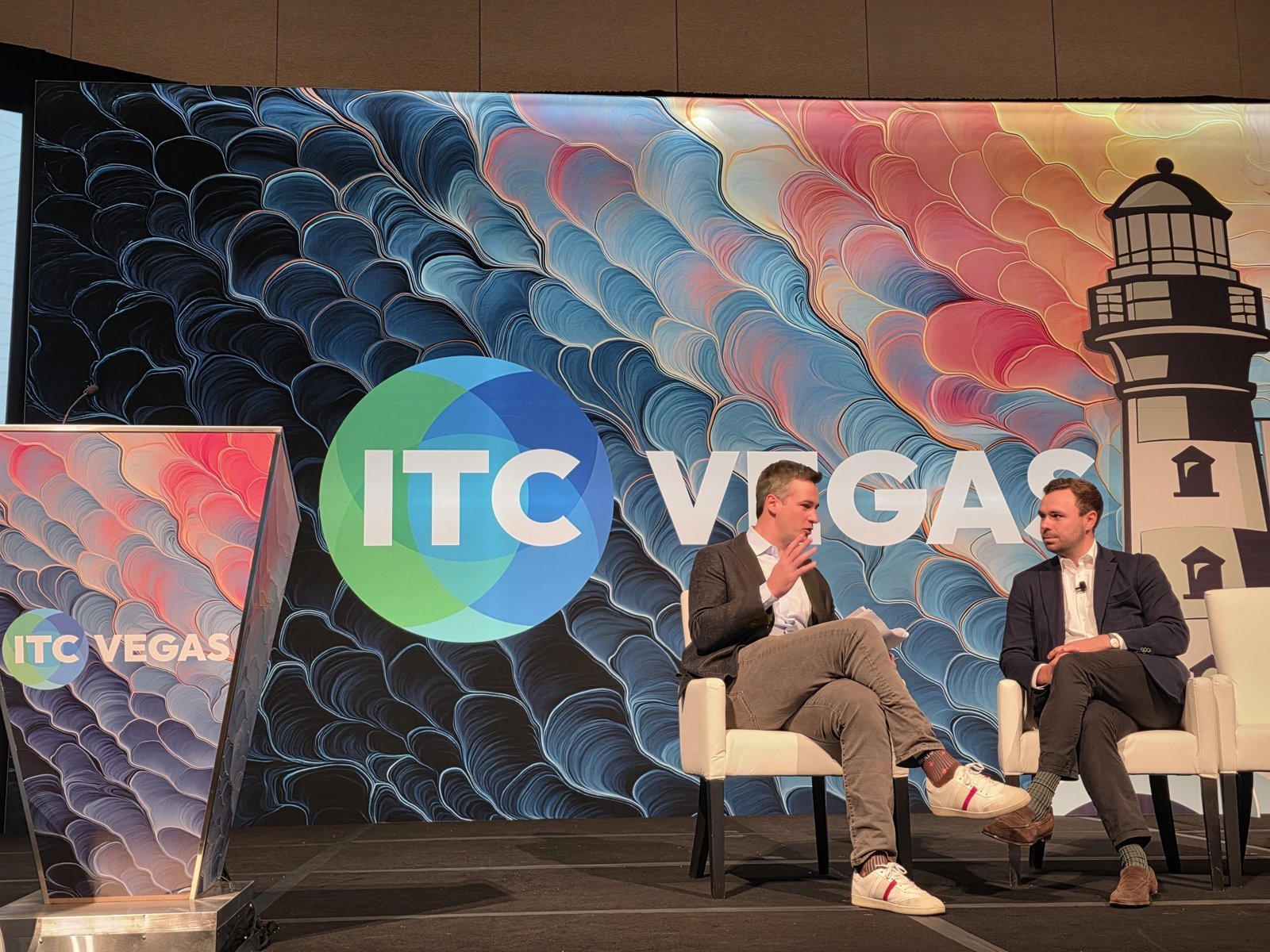
- Session
- Why some insurers get value from AI and some don’t, presented by Federato
- Stage
- AI-Powered Insurance Innovation Summit, ITC Vegas 2026, Mandalay Bay, Las Vegas
- When
- Tuesday, September 29, 2026, 10:10 a.m.
- Speakers
- Will Ross, CEO & Co-Founder, Federato
Freddie Scarratt, Global Deputy Head of InsurTech and Global AI Liability Lead, Gallagher Re
Key takeaways
- Freddie Scarratt of Gallagher Re split AI into two kinds. Efficiency AI saves hours but is hard to measure. Decision AI helps insurers underwrite better. The winners use the first to power the second.
- AI amplifies whatever it is fed. Bad data leads to bad decisions at scale, so clean data comes first.
- Federato’s research found 93% of leaders believe underwriting guidelines are applied consistently, while 88% of employees report deviations. Closing that gap is where AI earns its value.
- When an AI model goes wrong, the company using it can be liable, even if the model is not its own. Scarratt’s one word for what matters most: accountability.
LAS VEGAS: Nigel Walsh of ServiceNow introduced the two speakers as old friends and handed over a question every insurer is asking. Why do some companies get real value from AI while others spend millions and struggle to show a return?
Will Ross, CEO and Co-Founder of Federato, led the conversation. Freddie Scarratt answered from two seats at once: as a reinsurance broker, and as Gallagher Re’s new Global AI Liability Lead.
Why do some insurers get value from AI and others don’t?
Scarratt said he sees two kinds of AI being put to work. The first is efficiency AI, built to save hours. Companies spend heavily on it, he said, yet it is very hard for a finance chief to measure. If an underwriting team saves time but writes the same amount of business, what has changed?
The second is decision AI, which helps people underwrite better. That is the more interesting area, he said, and most good tools do some of both. The key is to use the time efficiency frees up to give teams the tools to make better decisions, faster. He expects the proof to show up over the next couple of years in numbers like more submissions handled and more business written by the same team.
Ross added a point about economics. In a technology company, most of the cost is people, so cutting labor is the big lever. An insurer is a different equation. Focusing only on labor savings misses the bigger drivers of the business.
Do leaders and underwriters see the same business?
Not according to Federato’s 2026 State of P&C Insurance Technology report. Ross shared one of its sharpest findings: 93% of leaders believe underwriting guidelines are applied consistently across their teams, while 88% of employees report deviations caused by missing data, disconnected tools or workflow limits.
Scarratt shared a story about one chief executive who uses an AI agent to let underwriters know, in the moment, when they step outside the guidelines. It is not meant to scare anyone, he said. People are good at making judgment calls, as long as they know whether they are inside the guidelines or outside them.
Is shadow AI a risk for insurers?
Ross said Federato’s research found widespread use of shadow AI: staff using AI tools that have no enterprise subscription, sometimes pasting confidential documents into a personal chatbot account.
Scarratt, speaking for himself, said companies need to let people experiment, because that is how new ideas start. But from a risk point of view, uploading company information to an outside tool is alarming. Confidential data belongs in the company’s own approved tools. And where AI talks to customers or makes business-critical calls, governance has to be complete, because the business using a model can be liable for its mistakes even when the model is not its own.
Can AI make bad decisions faster?
Yes, if the data is wrong. AI amplifies whatever it is given, Scarratt said, and bad data only leads to bad decisions, sometimes with results getting worse and no one sure why. That is why Gallagher is investing in a large data transformation before it leans harder on AI tools.
He also raised a deeper question for the industry. Insurance works by pooling risk. If insurers learn so much about each risk that they simply stop covering the worse ones, more people could become uninsurable. “It’s called risk for a reason,” he said.
Is AI a board-level priority for insurers?
Not the top one yet, Scarratt said. The biggest companies have many people working on AI because their technology budgets are so large. Smaller carriers, under about a billion dollars in premium, see AI as a way to compete with the giants. But in the board conversations he has had in recent months, the softening market, cyber rates and catastrophe trends came first, with AI appearing as a risk.
Asked why insurance has moved more slowly than fields like law, Scarratt offered a theory. Insurers were early and good at the first wave of internet technology, so they built large systems that new tools now have to fit into. Industries with less to build on can move faster. Ross added that the most nimble players tend to be the mid-sized carriers and MGA platforms that are willing to cut loose from parts of their legacy.
Who is liable when an AI model goes wrong?
This is Scarratt’s new job. Gallagher Re launched its Digital Risk Practice in August 2026, covering AI liability, data centers, cyber and digital risk engineering, and he leads the AI liability work. The question behind it is simple: what happens when the model underneath your business goes wrong, and are you insured for it?
Asked what insurers should think about when it comes to their own AI liability, his first answer was one word: accountability. After that, he said, comes tracking constant legal change and building frequency and severity models for a risk that has no loss history yet, using AI to help build them.
Why it matters for insurers
The insurers getting value from AI are not the ones buying the most tools. They are the ones fixing their data, using saved time to make better decisions, closing the gap between what leaders believe and what underwriters live, and knowing who is accountable when a model is wrong.
Both speakers have shaped ZERO LEGACY, the new book from Zero Legacy Press. Will Ross’s warning that you can’t draw a new future on a broken canvas appears in Chapter I, and Freddie Scarratt’s work on AI liability appears in Chapter IV, The Accountability Layer.
Who spoke at the session
- Will Ross, CEO & Co-Founder, Federato
- Freddie Scarratt, Global Deputy Head of InsurTech and Global AI Liability Lead, Gallagher Re
- Nigel Walsh, Head of Insurance Go-to-Market, ServiceNow (introduction)