
- Session
- The AI-first agency: Your 30-60-90 day plan in 15 minutes
- Stage
- ITC Agents, Workflows & Optimization Stage, Ballroom G, ITC Vegas 2026, Mandalay Bay, Las Vegas
- When
- Tuesday, September 29, 2026, 11:00 a.m. to 11:15 a.m.
- Speaker
- Dave Rose, Head of bolt Agency, bolt
Key takeaways
- Don’t make AI a tech project. Dave Rose of bolt said agencies should treat it as an operating decision: one workflow, one metric.
- Start with friction, not AI. His agency’s friction was the first minute of a phone call, so it replaced a press-one, press-two phone menu with an AI receptionist on a single line.
- Pick work that is repetitive, measurable and recoverable, so a person can always step in.
- Follow a 30-60-90 day plan: choose and prepare, pilot and learn, then prove and expand, scaling only what worked. Conversion nearly doubled over time, not on day one.
LAS VEGAS: Dave Rose runs the bolt Agency, a digital agency that works much like any independent agency, inside the insurance distribution platform bolt. Before that he spent years with Travelers and Liberty Mutual, working with independent agents. His 15-minute talk on the ITC Agents stage was built for agencies that don’t know where to start with AI.
Why do AI projects stall in insurance agencies?
Rose opened with his own story. Two years ago he walked the ITC floor and left with 20 AI ideas. Back at the office, he put none of them to work. Every idea needed a product team, a budget committee and a formal project.
His lesson for the room: this is not a tech initiative. It is an operating decision about how your agency works. His advice was blunt. Do not make it a project. Whether your agency is small or large, dip a toe in the water and keep it simple.
Where should an agency start with AI?
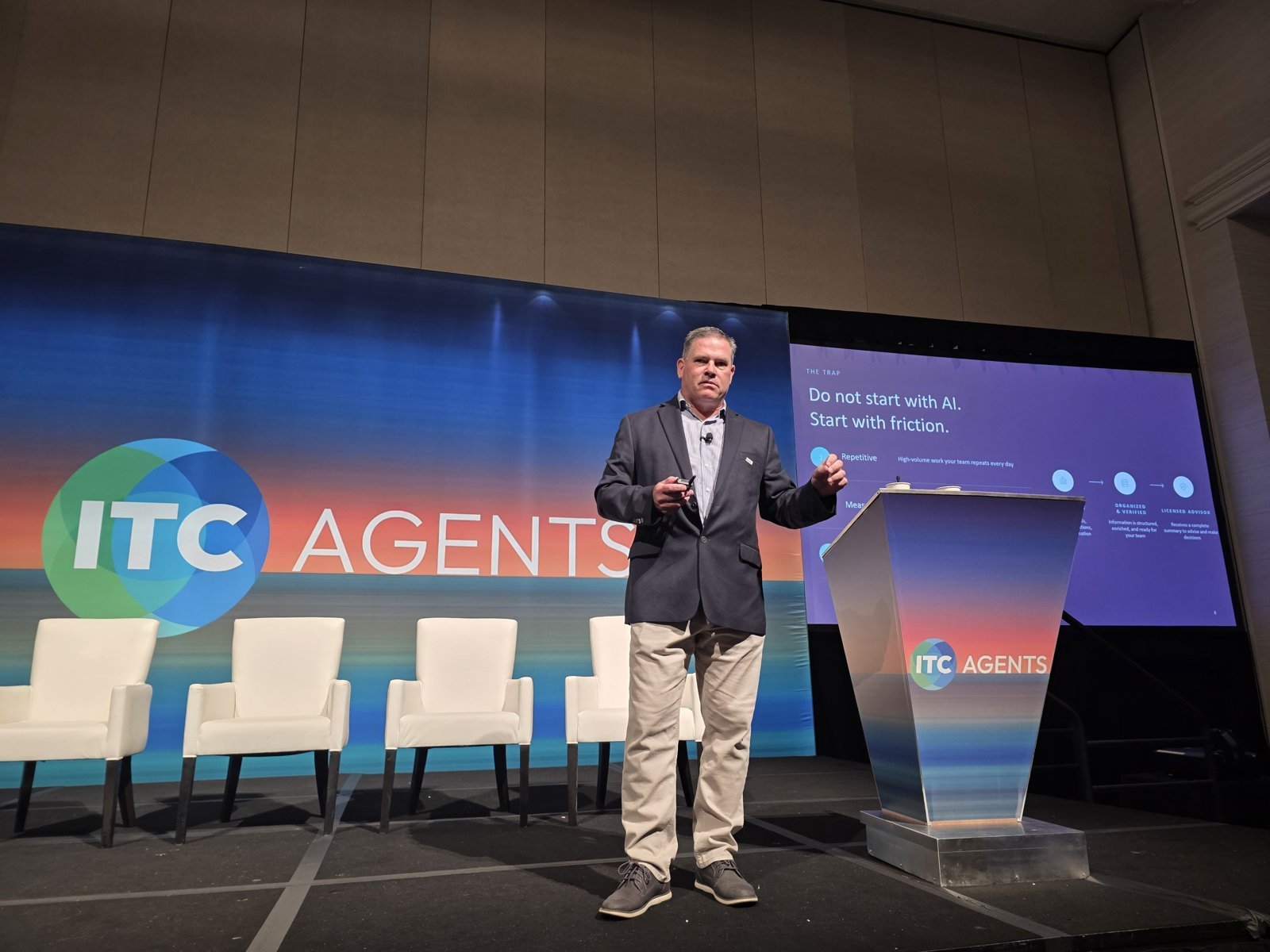
The slide behind him said it plainly: “Do not start with AI. Start with friction.” Rose’s first step was to ask his own team a simple question: what are your pain points?
For his agency, the friction sat in the first minute of a phone call. Callers hit a phone menu: press one for sales, two for service. Rose replaced it with an AI receptionist that simply asks how it can help, and he put it on just one phone line. One process, one line, one metric.
Which workflow is right for a first AI pilot?
Rose gave three tests. The work should be repetitive, meaning high-volume tasks the team repeats every day. It should be measurable, so you can see whether it worked. And it should be recoverable, so AI supports the agents rather than replacing them, and a person can always step in.
Agents are good at building relationships, counseling on coverage and giving advice, he said. Let AI take the simple, repeated steps so agents have more time for that. He also told the room not to worry about writing scripts. The AI vendor can build them with you.
What is the 30-60-90 day AI plan for agencies?
Rose’s launch plan fits on one slide:
30 days: Choose and prepare
Map one workflow. Capture the baseline. Set the guardrail.
60 days: Pilot and learn
Start with a small audience. Review exceptions weekly. Coach the team.
90 days: Prove and expand
Compare to the baseline. Document the playbook. Scale only what worked.
His challenge to the room: go back to your agency in the next couple of weeks and find just one workflow. You will find twenty things you want to do, he warned. Stick with the one.
What should agencies ask AI vendors?
Two things, Rose said. First, ask for a free pilot with no commitment and no risk on the one workflow you have chosen. Many vendors offer that. Second, remember that not every vendor is the same. Some are great at AI but not built for insurance. Look for one that can put an insurance-focused agent to work quickly.
What results can an agency expect?
Results built over time, not on day one. Rose said his team’s conversion rate nearly doubled, because customers now reached agents ready and prepared. From there his agency added more: AI that asks the right questions up front, including some underwriting questions, so an agent starts the conversation with the documents already in hand. Later came outbound calls, for example to customers who have missed a payment or are at risk of not renewing.
Once you start, he warned with a smile, it becomes addictive.
Do you need clean data or integrated systems first?
No, Rose said. Many agencies worry that their data is not clean enough, or that their management system and CRM will get in the way. Your tech will not get in the way, he told the room. On day one an AI pilot will not be integrated with your CRM or agency management system, and you should not want it to be. Keep it simple and repetitive, and keep going.
Why it matters for insurers and agencies
The agencies that get value from AI will not be the ones with the longest list of ideas. They will be the ones who pick one real friction point, prove it against a baseline, and grow from there.
It is the same discipline ZERO LEGACY, the new book from Zero Legacy Press, lays out for carriers on page 61, in Chapter II: sequence by business value, not by system, wrap your highest-friction workflow first, prove it, then expand. Rose showed that an agency can start on Monday.