
- Session
- How to start using AI agents to scale your personal and small commercial lines
- Stage
- ITC Agents, Workflows & Optimization Stage, ITC Vegas 2026, Mandalay Bay, Las Vegas
- When
- Tuesday, September 29, 2026, 11:20 a.m.
- Speaker
- Jon Corrin, CEO & Co-Founder, XILO
Key takeaways
- Jon Corrin of XILO said the problem is not that AI is moving too fast. It is that customers are moving faster than agencies.
- He expects a near future where a customer’s AI agent talks to a broker’s agent, which talks to wholesaler and carrier agents.
- An AI agent needs eight things to do real work: a job, context, connectors, software for the steps that cannot vary, documents, a computer, routines and guardrails.
- Start with one job that is holding back growth, such as certificates of insurance. Add a knowledge manager agent for your procedures, give the bot its own mailbox, and keep a person approving what goes out.
What will buying insurance look like in 2030?
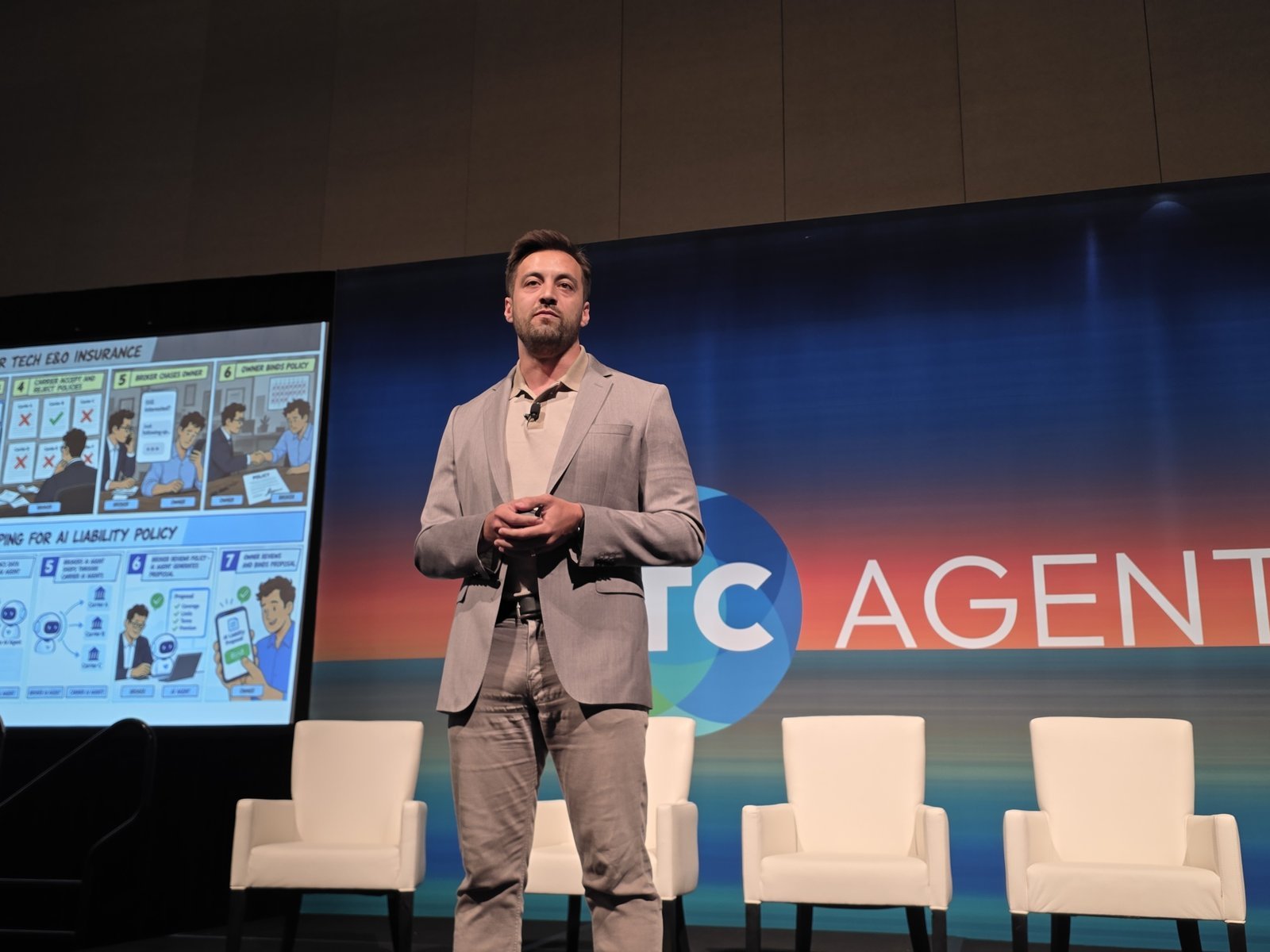
LAS VEGAS: Jon Corrin opened with a story about a business owner called Jim. Jim needs a cyber policy to close a big deal. He calls around for broker names, spends a whole Tuesday night filling out forms instead of being with his family, waits while the broker shops the market, and then spends weeks trading calls before he finally binds a policy.
Then Corrin revealed the twist: he is Jim. As a founder, he went through exactly that process to buy cyber cover and close one of his company’s biggest contracts.
In his picture of 2030, Jim simply tells his own AI agent that he needs cover. The agent finds a specialist broker and shares Jim’s business data through secure connections. The broker reviews and checks it, the broker’s agent shops carrier agents, a proposal comes back, and Jim binds. Hours, not weeks. His point was that 2030 is starting to look a lot like today.
Are customers adopting AI faster than agencies?
“The problem isn’t that the stuff is moving too fast. The problem is that our customers are moving faster than we are.”
Jon Corrin, XILO
The research backs up the gap. The Accenture Consumer Pulse 2026 survey of 25,590 consumers found 74% would let an AI agent handle routine tasks such as negotiating deals and renewing subscriptions, though far fewer would let one complete a purchase on its own. Meanwhile the Big “I” Agents Council for Technology report found only 8% of independent agencies have AI built into their daily work.
Agents are advocates for their clients, Corrin said, so agencies have to meet customers where they already are. He expects a world where a customer’s agent talks to a broker’s agent, which talks to wholesaler and carrier agents.
What is an AI agent, and how has it changed?
Corrin has built workflow automation for brokers since 2018, and AI agents since 2023. His slides noted that XILO was founded by brokers, has served more than 500 insurance distributors, and has more than 100 customers using its AI agents. Inside his own 75-person company, a dozen or so agents now help run sales and service.
He described three stages. First came chat tools that answer a question. Then came agents that handle a bigger task, such as drafting a proposal. Now comes what he called agent 2.0: agents that hold a job and do it routinely. For example, every time a request comes in, a service agent prepares the certificate of insurance, and a service rep signs and sends it.
What does an AI agent need to do real work?
Corrin’s slide listed eight things:
A job
A scope a person would recognize.
Context
Your rules, your procedures, your history.
Connectors
A way to reach into the systems you run.
Software
For the steps that cannot vary.
Documents
The ability to read them and produce them.
A computer
So it can click, browse and code.
Routines
A schedule, so it runs without you.
Guardrails
Rules it is not allowed to break.
Where should an agency start with AI agents?
First, pick one job that is holding back growth. His list included certificate generation, proposals, ACORD forms, renewal preparation, policy checking, claims status chasing, loss run requests, statements of values, cross-sell campaigns, endorsement requests and onboarding packets. Then pick a tool that can actually hold a job: one that runs on a schedule and calls other tools, rather than one that can only answer questions.
His worked example was certificates of insurance, a task that takes his own team a lot of time. Alongside the service agent, he recommends a second agent he calls a knowledge manager. It builds and maintains the standard operating procedures, and every night it asks the other agents what they learned that day and updates the procedures. His knowledge manager looks after about 14 agents.
How do you connect an AI agent to agency systems?
Step three is connectors. His required list: a mailbox, the agency management system for policy data in and out, and a shared drive for files. A CRM for the activity log and a chat tool, so the agent can ask a person a question, were optional. One simple rule from the slide stood out: give the bot its own mailbox, not a person’s.
Connecting the agency management system is often the hardest part. Corrin explained the Model Context Protocol, or MCP, as a standard way for AI and business systems to talk to each other. If your system does not offer one, he gave three options. Wrap its API yourself, which is the right answer and the expensive one, and you own that connection afterward. Ask for a data export, with a named person exporting once and then only what changed on a timestamp. Or let the agent use the computer directly, which is slowest and hardest to keep logged in.
Does a person stay in charge?
Yes. One slide showed a renewal agent that had found 34 policies renewing within 90 days, 11 of them home-only. Asked to draft a bundle campaign for those 11, it replied that it would show the copy before anything was sent. Guardrails, a way to ask a person, and a review step are built into the design.
Why it matters for insurers and agencies
Agent-to-agent insurance is not a distant idea. Customers are already handing routine tasks to AI, and the agencies that set up one well-defined agent job now will be ready when their customers’ agents come calling.
Chapter V of ZERO LEGACY, The Agentic Frontier, from Zero Legacy Press, argues that distribution is moving machine to machine, and that insurers need an open, machine-readable way for agents to transact. Page 61 makes the practical point Corrin made on his connectors slide: use open protocols such as MCP, not one-off integrations.
Who spoke at the session
- Jon Corrin, CEO & Co-Founder, XILO