
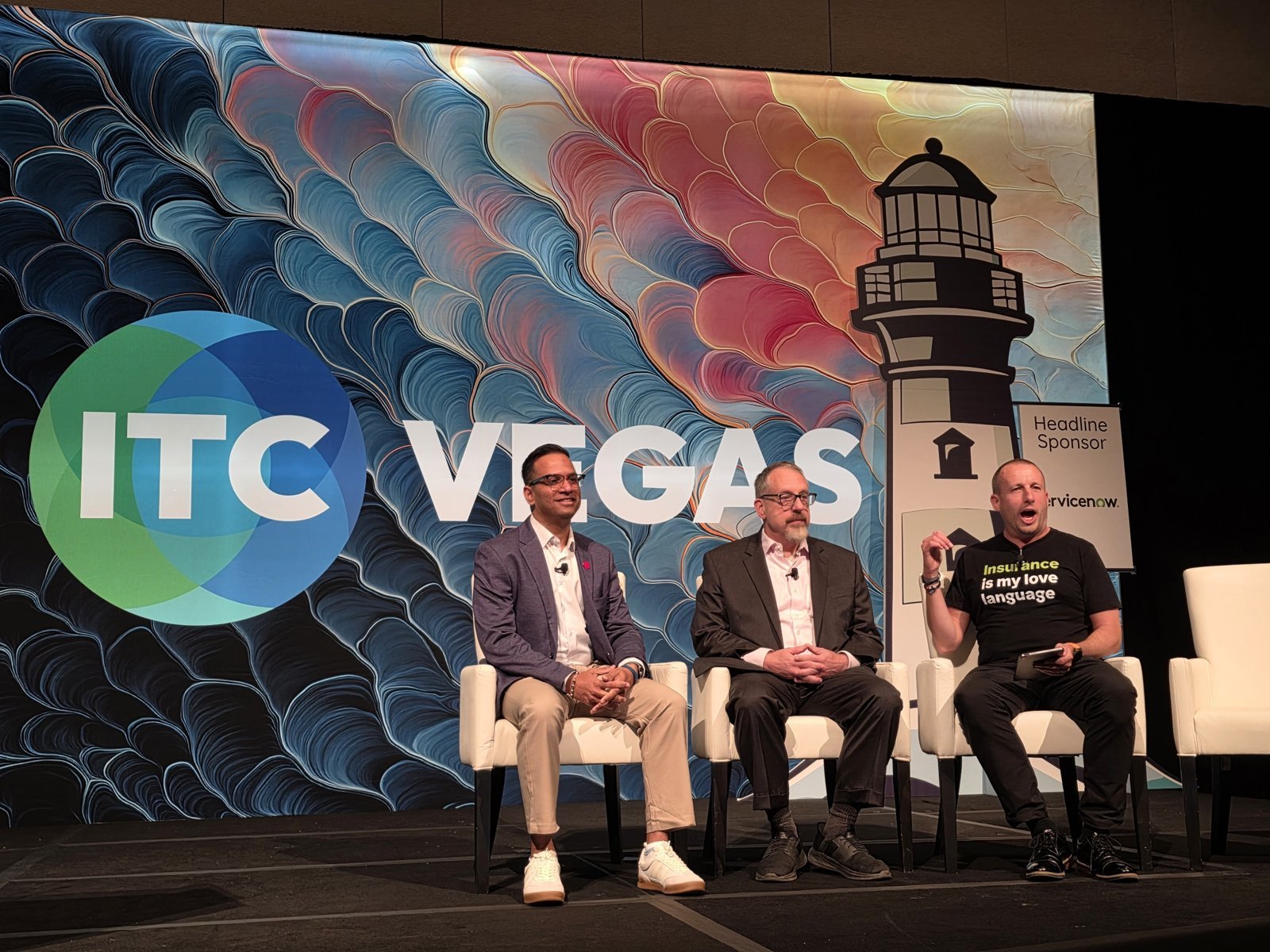
- Session
- The AI control tower: Orchestrating insurance operations end-to-end, presented by ServiceNow
- Stage
- AI-Powered Insurance Innovation Summit, ITC Vegas 2026, Mandalay Bay, Las Vegas
- When
- Tuesday, September 29, 2026, 9:30 a.m.
- Moderator
- Nigel Walsh, Head of Insurance Go-to-Market, ServiceNow
- Speakers
- Robert Pick, Executive Vice President and Chief Information Officer, Tokio Marine North America
Sai Vishnubhatla, Head of AI and Product Innovation, USAA
Key takeaways
- Sai Vishnubhatla of USAA said the real question is whether insurers are governing a 2026 technology with a 2016 operating model. Governance has to keep pace with AI agents, not act as a one-time gate.
- Robert Pick of Tokio Marine North America said AI has outrun the industry’s ability to monitor and control it, but governance can catch up. Large insurers need one safety layer that sees across every AI platform.
- Both agreed the moat is the operating model, not the AI model. Putting AI on a 20-year-old process only makes that process faster.
LAS VEGAS: Nigel Walsh opened the second session of the AI summit by poking fun at the doom headlines that filled the week before. The world had not ended, he noted, and the room was full. Then he asked his two guests the question behind the session. Is it too late to get AI under control?
Are insurers governing AI with an old operating model?
Sai Vishnubhatla, Head of AI and Product Innovation at USAA, said that is the wrong question. The better one, he said, is this:
“Are we trying to govern a 2026 technology with a 2016 operating model?”
Sai Vishnubhatla, USAA
Old software waited for someone to use it. Early AI tools answered what you asked them, which made them fairly predictable. Agents are different, he said. You give them a goal and a set of tools, and they work out the rest. So governance cannot be a single gate before something goes live. It has to keep up with a system that changes as it runs.
Can AI governance in insurance catch up?
Walsh reminded the room of something Robert Pick has said before: that governance runs about a year behind what AI can do. Is the gap still there?
Pick, Executive Vice President and Chief Information Officer at Tokio Marine North America, agreed that AI has outrun the industry’s ability to monitor, control and observe it. He split the problem in two. Governance checks that systems work the way they are supposed to, a bit like a controls audit. Safety is watching what an agent is trying to do in real time, and allowing it, stopping it or redirecting it.
A large insurer, he said, does not want to run six, eight or fifteen separate safety tools, one for each platform. It needs a single layer that can see across all of them. He compared it to the early days of IT infrastructure, before tools arrived that could manage all the other tools.
Can the industry catch up? He believes it can. Many of the big productivity claims at conferences, he said, come from a small team running one line of business. Scaling that across a global insurer is a different job, and that scaling time gives governance room to catch up. He added a practical point for finance teams: when a tool may be replaced in a year or two, think hard before carrying it on the books for five to seven years.
Should insurers move faster on AI?
When Walsh asked how carriers can move faster, Pick pushed back.
“I don’t have a goal of speed.”
Robert Pick, Tokio Marine North America
Insurance exists to help people on the worst day of their life, or the worst day of their business, he said. If insurers start taking wild risks themselves, they undermine the reason the industry exists. That does not mean standing still. It means moving at a pace that makes sense for customers, markets and business partners.
He also asked for fairer comparisons. Insurers get measured against startups with no customers and no legacy systems, or against the biggest tech companies in the world. “I don’t have the tech capabilities of Meta,” he said. That is not an excuse, he added. It is reality.
What do insurance customers expect from AI?
Vishnubhatla described the pressure from the other side. When a member calls, he said, they are not comparing USAA with another insurer. They are comparing it with Amazon, and with whoever answers their question on the spot. Some members now arrive quoting what a chatbot told them their insurance should cost.
So insurers have to catch up, he said, but with AI that is bounded. It should have clear limits. It should be able to explain itself. And its owners should be able to explain it to their board. Walsh added a phrase he had heard from a CEO that fits the moment: strategic patience.
Why is the operating model the real moat?
Walsh then put the session’s big idea on the table: the real difference between insurers is not the AI model they choose, but the operating model around it. Vishnubhatla agreed. The moat, he said, is the operating model.
In practice, that means not using a very powerful model for a simple job like summarizing a PDF. It means treating AI agents as systems that need regular care and good data, not software you install once and forget. And it means risk governance cannot be an afterthought. He also warned against a familiar trap.
“If you put AI on a 20-year-old process, you’re just making a 20-year-old process faster.”
Sai Vishnubhatla, USAA
Pick described the control layer he expects every large insurer to need: one that knows which models are in use and what they cost, routes each task to the right model, applies the rules, and watches not just for security problems but for whether the work is appropriate. He also noticed that companies with years of robotic process automation behind them are often doing better with agents, because they already have the habit of redesigning a process before automating it. The old tools still have a place, he said. If a simple automation does the job at the lowest cost and risk, keep it.
Where is AI already working in insurance?
Both speakers pointed to claims first. Pick described a 10,000-page claim file, and the value of giving the person who picks it up a first draft of a summary, with a person still making the call. In commercial underwriting, he said, a new submission can now be read, checked against appetite and enriched with public information in about a minute. He called that productivity, not yet transformation, but hugely valuable all the same.
He also named an overlooked success: insurers’ own IT teams, which he said are already using AI at scale. Vishnubhatla added document summarization and customer service, and said underwriting is moving from older machine learning to newer transformer models.
Asked how to keep up, both gave the same advice in different words. Vishnubhatla urged people to build something themselves, now that the cost of making software is close to zero. Pick said he tells his team the best professional development right now is to use AI in their personal lives.
Why it matters for insurers
Two leaders from very different insurers reached the same conclusion. The winners will not be the ones with the newest model. They will be the ones who redesign the work, set clear limits, and can explain every decision to a customer, a regulator and a board.
That is the argument of Chapter III of ZERO LEGACY, The Operating Model Is the Strategy, from Zero Legacy Press: the asset is not the model, it is the operating model. Robert Pick’s observation that governance runs about a year behind what AI can do also shaped two chapters of the book.
Who spoke at the session
- Nigel Walsh, Head of Insurance Go-to-Market, ServiceNow (moderator)
- Robert Pick, Executive Vice President and Chief Information Officer, Tokio Marine North America
- Sai Vishnubhatla, Head of AI and Product Innovation, USAA