
- Session
- Unlocking the AI multiplier, presented by Akur8
- Stage
- AI-Powered Innovation Summit, Mandalay Bay Ballroom K, ITC Vegas 2026, Las Vegas
- When
- Tuesday, September 29, 2026, 11:40 a.m.
- Speakers
- Thomas Holmes, Chief Actuarial Officer, and Ludovico Capparelli, Head of AI Transformation, Akur8
Key takeaways
- Thomas Holmes of Akur8 said the real bottleneck for AI with actuaries is trust, not speed. If actuaries cannot audit the work, they will not use it.
- Akur8 found that its early AI gains were held back by old review processes and culture, not by the technology.
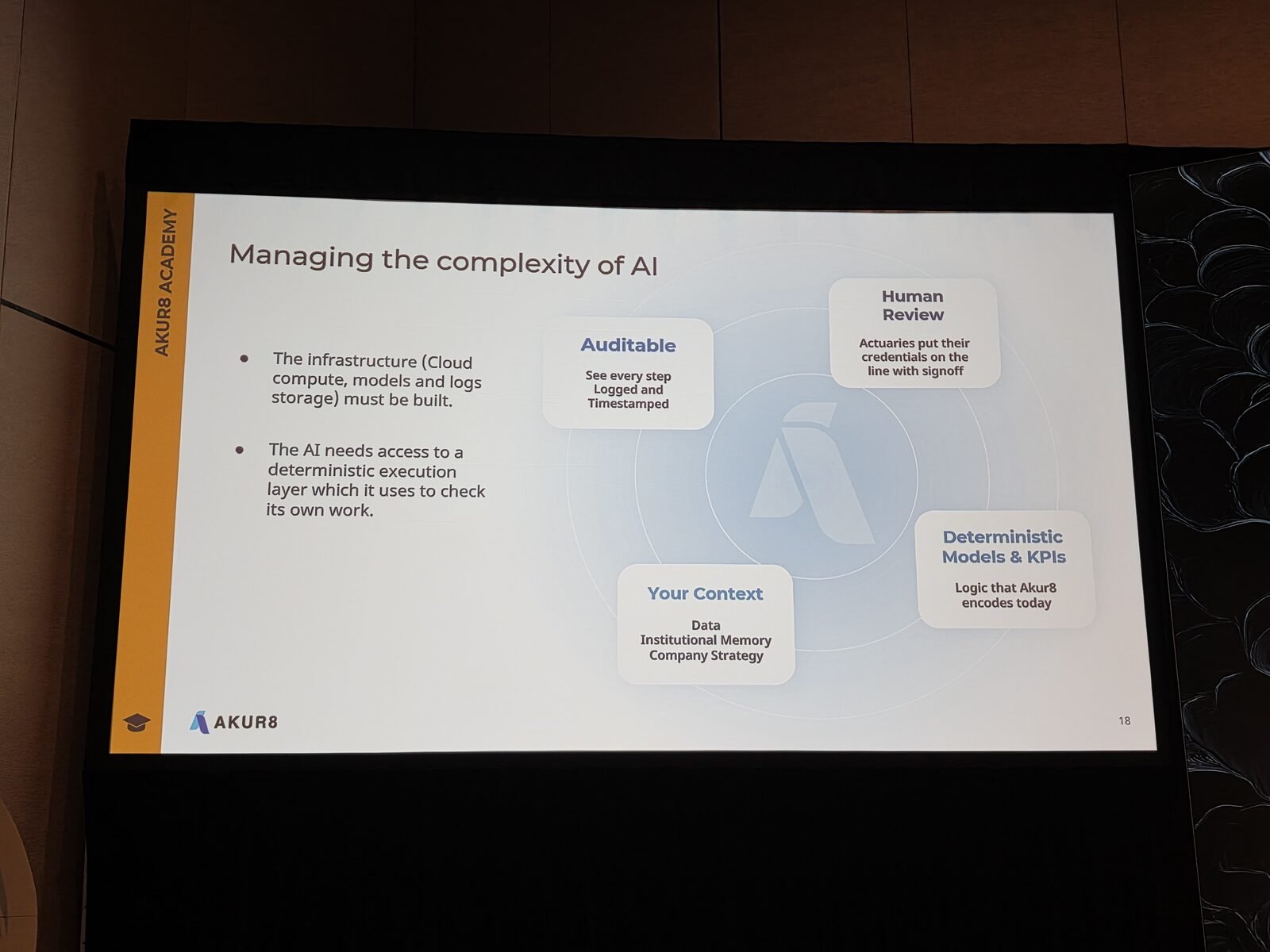
- Ludovico Capparelli said AI should not work out a premium by itself. It should call a deterministic layer the company already trusts.
- Asked where the line sits, Holmes said AI will create the numbers, and actuaries will decide what those numbers mean.
Why did a five-day AI feature never ship?
Capparelli opened with a story from Akur8’s early days with AI. One of its top engineers used AI tools to build a feature in five days. The same kind of work had taken a team of engineers three to six months.
It never went out to customers. An enterprise product has to pass reviews, validation and quality checks, and the team could not validate the new feature the way it was built. So nobody trusted it. The review process had been designed for the speed and scale of work before AI. Until the company changed how it checks work, the gains stayed on paper. In his words, “it wasn’t as much a technical challenge.” It was a people and culture problem.
How did Akur8 change its culture around AI?
Akur8 set up an AI transformation team. It is made of leaders from across the business, not only product engineers but sales executives too. These are people who know where the old rules sit and can reshape them. The slide listed the rest: honest talks about the risks, small team coaching, set time for everyone to explore AI, and champions who sit down with the people who adopt later.
Holmes shared a lesson of his own. When Slack messages started arriving that were clearly written with AI, his first thought was, “Did you do any work?” Then he saw that people were saving time. In a company that works in many languages, it was often just a way to clean up the English. Now he assumes the message is checked and complete, and he gives feedback as usual. Leadership, he said, is now even more about vision. Teams get more freedom, and ideas get pruned early.
Why is actuarial work different from other work?
Holmes was clear that actuaries cannot move the way a software team can. His slide said hallucinations can lead directly to insolvency and regulatory action. Actuaries set reserves. Regulators act on pricing. Only some actuarial judgment can be copied by a model, and the profession runs on strict credentials.
He made a prediction: in about three years, someone will lose their actuarial credential over improper use of AI. He also warned that a regulator can ask, years later, why a number was set. If you cannot replay the logic, you are exposed. He pointed the room to Precept 1 of the actuarial Code of Professional Conduct, which asks actuaries to act with integrity and competence and to uphold the reputation of the profession. He called that last part the most important.
“Your real bottleneck with actuaries is trust.”
Thomas Holmes, Akur8
What is constraint engineering?
Capparelli explained how Akur8 now builds with AI. If you let AI run free across a complex system, you end up with a tangle that no person can understand. For a company that sells software to insurers, losing control of the system is not an option.
So the system is split into smaller parts. People design each part and set its limits, which are human and software checks that always give the same answer. The AI then works inside those limits. Holmes gave an actuarial example. The rules for how data is grouped and totaled should be written down as fixed logic first, and the AI should use those rules rather than make up its own. Otherwise, he said, you will not know if your data has gone wrong.
What four controls keep AI trustworthy in actuarial work?
Auditable
Every step is logged and timestamped, so anyone can see exactly what happened.
Human review
Actuaries put their credentials on the line when they sign off, so a person checks the work.
Your context
Data, institutional memory and company strategy, organized so the AI can search it.
Deterministic models and KPIs
Rating, KPIs, reports and filings run on a fixed execution layer, not inside the AI.
On context, Capparelli said good documentation, even going back thirty years, is now a real advantage. “The context you can build as an organization becomes your source of truth,” he said. Holmes then asked him a question they had not rehearsed: what if a mistake gets into that context? Capparelli’s answer was that data quality now matters more than ever, because a mistake in the context repeats every time.
On pricing, Capparelli was firm. Even if you give an AI model every rating rule in its prompt, it will not always give the same answer, because these models are not deterministic. The premium should come from an execution layer you already trust. The AI calls it and uses the result.
Where does AI stop and the actuary take over?
With seconds left, I asked from the floor where the line sits between what AI can decide and what needs an actuary’s sign-off. Holmes answered in one breath:
“AI will create the numbers. Actuaries will decide what that number means and if that number is reasonable.”
Thomas Holmes, Akur8
He added that AI might one day produce a draft statement of actuarial opinion, but the line is drawn at credibility and auditability. He does not see AI wiping out junior actuaries either. Nobody needs a new actuary to copy and paste cells anymore, he said, but “I need you to be able to look at a lift curve and see if it actually makes sense.” That, he said, is the heart of actuarial judgment.
Why it matters for insurers
For carriers and MGAs, the message is simple. AI can already do the work many times faster. The limit is whether the people who sign the numbers can trust and explain them. Insurers that build the audit trail and the fixed pricing layer first will get the speed. Those that skip it will get a tool their actuaries refuse to use.
Chapter I of ZERO LEGACY, from Zero Legacy Press, draws the same hard line Capparelli drew on stage. On page 33, the language model works only on language and “is forbidden from ever producing the priced number.” Chapter II, page 48, “Validate the Input, Not Just the Output,” warns that a confidently wrong extraction produces a flawless price for the wrong risk, and says plainly: “Actuaries will not, and should not, accept this.”
Who spoke at the session
- Thomas Holmes, Chief Actuarial Officer, Akur8
- Ludovico Capparelli, Head of AI Transformation, Akur8