
- Event
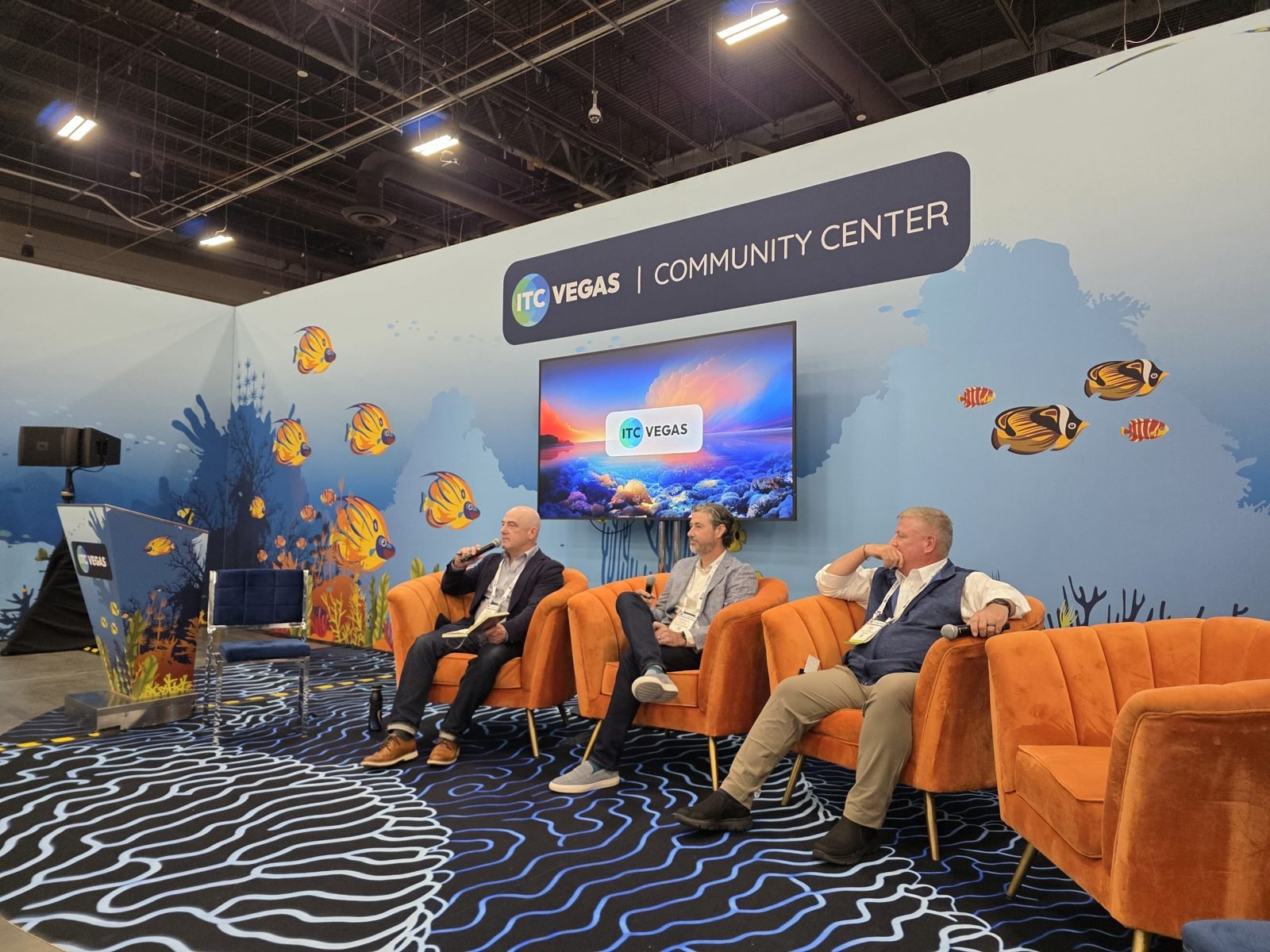
- ITC Vegas 2026 (InsureTech Connect), ITC Community Center on the expo floor
- Venue
- Mandalay Bay, Las Vegas, Nevada
- Date
- Thursday, October 1, 2026
- Session
- The agentic insurer: from AI ambition to action, presented by AWS
- Speakers
- Terry Buechner, Principal Insurance Specialist, Global Core Systems, AWS (moderator); Patrick Gallic, Head of the International AI Hub, Tokio Marine Group; Tony Jacob, Head of Insurance, OpenAI
Key takeaways
- Most carriers have at least one agent-driven process in production, but Tokio Marine’s Patrick Gallic said almost no one has 10 percent of their processes there yet. The work now is scaling.
- OpenAI’s Tony Jacob said the technology “is advancing so much faster than our industry is adopting,” and the next opportunity is insurance-specific workflows, not general back-office productivity.
- Gallic said real change comes when agents bring in new data, not just speed up old steps. Otherwise, “we’re competing with BPO.”
- A pilot with 99.9 percent accuracy still could not scale, Gallic said, because it had no model evals, no model routing and no cost controls.
- Letting an agent decide is a delegation of authority, and you cannot hand the liability to the agent. Governance has to catch a mistake before it happens, with a kill switch.
Where are insurers with AI agents today?
Moderator Terry Buechner of AWS asked for a temperature check. Patrick Gallic, who leads AI for Tokio Marine’s companies outside Japan, put it to the room. Many hands went up when he asked who had an end-to-end process running with agents in production. None went up when he asked who had 10 percent of their processes there.
The proof-of-concept stage, he said, was 2024 and 2025. Now the question is scale: taking something that works for one line of business to many, and “scaling the autonomy of what the agent can do.”
Tony Jacob, five weeks into his role as Head of Insurance at OpenAI after leading insurance at AWS and Microsoft, agreed that most carriers are still keeping a person in the loop, which he said makes sense in a regulated industry. Most use today, he said, is horizontal back-office productivity. The unrealized opportunity is industry-specific workflows, and helping the many insurers that buy rather than build. “We’re still early days. I don’t think anybody should feel that they’re behind,” he said. But the technology “is advancing so much faster than our industry is adopting.”
What makes AI “agentic” in insurance?
Jacob offered a simple ladder using a flooded basement. A chatbot answers the question and finds the right ACORD form. An agentic service handles the whole process: it prefills the forms, gathers the damage details, preps the adjuster and lines up repair partners. Agentic AI goes one step further, with several agents coordinating with each other. That, he said, lets insurers finally “design the process as the business envisions” instead of around legacy systems.
Gallic defined it by agency: an agent can make a decision and act on it. He warned that using agents only to hit every step faster is “not really doing more than RPA.” His example was Tokio Marine’s marine cargo team in Indonesia, which cut its submission-to-quote process from three hours to a handful of minutes. The bigger change, he said, was that the team brought in data it never had before, such as weather forecasts and boat ownership. “Otherwise, it’s just we’re competing with BPO.”
He also cautioned against using AI at every step. In his experience, about 80 percent of the steps in a process are deterministic. The aim is “creating a deterministic process by using a non-deterministic solution,” calling on AI only where judgment is needed.
Why do successful pilots fail to scale?
Gallic’s criteria for any pilot: it must be executive sponsored, show growth, have a good return and be scalable. He sees three kinds of AI work. Individual productivity is necessary but will not move the bottom line. Workflow speed is table stakes, because if a rival quotes in a day and you take a week, you get adversely selected. The real advantage, he said, comes from using your own data to create something new.
Then he shared what he called “a great success story that maybe wasn’t a great success story.” A submission ingestion project reached 99.9 percent accuracy, and staff no longer had to check its work. But when the team tried to reuse it elsewhere, they found five direct API calls with no model evals, no model routing and no cost controls. It worked, but it could not scale. Now, he said, every project needs a model router, evals against a golden set tested daily for drift, cost controls and a named owner.
Jacob called for a platform approach: one layer for governance, observability and the token economics of AI, with the freedom to pick the best model for each job and to shop for computing power. That optionality matters for cost. Gallic said a recent Tokio Marine test on reading documents found more than a 50 times cost difference between models that reached the same result, and warned that public benchmarks are no substitute for testing on your own data.
What does good governance look like when agents decide?
Gallic named scalability and governance as his two biggest concerns going into 2027. He described a path from AI as thought partner and adviser, to deciding, to acting, and finally to orchestrating whole systems. When an agent decides for you, he said, it is a delegation of authority. A person you delegate to has interviews, reviews and a job to lose. An agent has none of that, and you cannot transfer liability to it.
That changes how security works. In the past, a breach was found and then patched. With agents in a regulated industry, he said, “We actually have to observe it that it’s going to make a mistake, and then have some sort of kill switch.”
Jacob kept it simple: “think about the sensitivity of the decision, how much judgment is required.” That decides whether a process can be autonomous or keeps a person in the loop.
How do leaders and teams need to change?
Gallic said everyone needs access to AI tools and training, but the most important training is technical education for leaders. Vendor demos all look alike, he said, so experienced underwriting and claims leaders cannot make big AI decisions without understanding what is under the hood. Jacob said that at OpenAI’s executive briefings, leaders spend about half an hour building their own “chief of staff” agent. “You gotta feel it viscerally,” he said.
Asked by Zero Legacy Press what changes for a team once agents are put to work, Gallic answered with people, not technology. Underwriters want to work with brokers and price risk, and adjusters want to settle claims fairly with claimants. Over 30 years, he said, a big share of the job became data entry. “The more you can remove the data entry work and focus more on what needs to be done by an insurance company, the more the joy of your team goes up,” he said.
Why it matters for insurers
The panel moved the conversation from “should we use AI” to “who is accountable when it acts.” Scaling agents takes routing, evals, cost control and owners. Letting them decide takes guardrails that stop a mistake before it reaches a customer or a regulator.
ZERO LEGACY, from Zero Legacy Press, gives this problem a name: “the liability gap of delegated authority.” Read about the book
Who spoke
- Terry Buechner, Principal Insurance Specialist, Global Core Systems, AWS (moderator)
- Patrick Gallic, Head of the International AI Hub, Tokio Marine Group
- Tony Jacob, Head of Insurance, OpenAI