
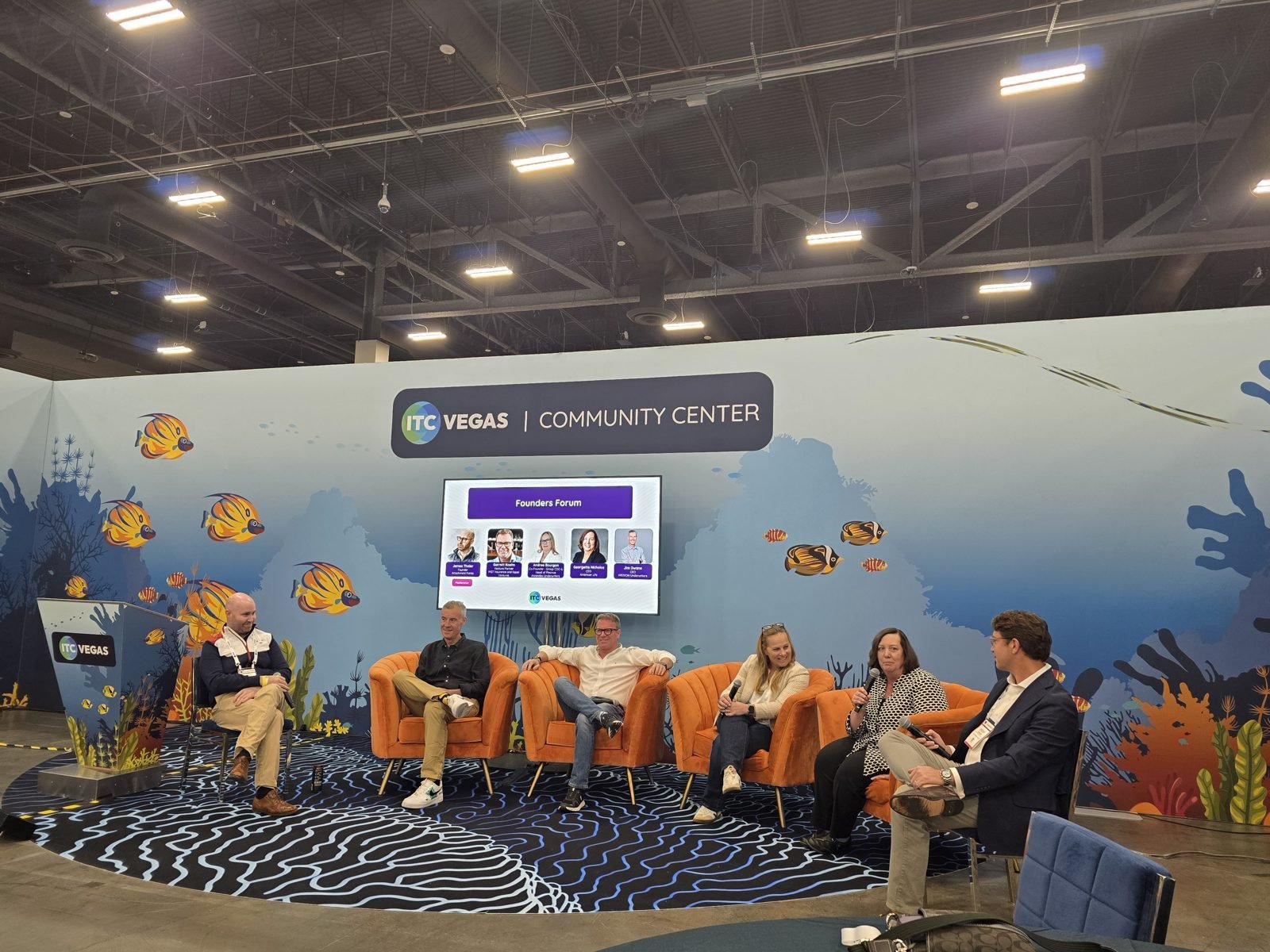
- Event
- ITC Vegas 2026 (InsureTech Connect), ITC Community Center on the expo floor
- Venue
- Mandalay Bay, Las Vegas, Nevada
- Date
- Thursday, October 1, 2026
- Session
- Founders Forum
- Speakers
- James Thaler, Founder, Attachment Points (moderator); Jim Dwane, CEO, MISSION Underwriters; Garrett Koehn, Venture Partner, Equal Ventures, and adviser to MGT; Andrée Bourgon, Co-Founder, Group COO and Head of Finance, Ascendex Underwriters; Georgette Nicholas, CEO, American Life; Jeremy Eisemann, Chief External Affairs Officer and Deputy General Counsel, Corgi
Key takeaways
- MISSION CEO Jim Dwane described an “entrepreneur’s continuum,” from the solo founder to the fully supported founder, and said no point on it is better than another. What matters is being honest about where you will succeed.
- On AI, his warning was simple: it can help you think, but “it’s not taking any risk with you. It’s not providing you any capital.”
- Ascendex’s Andrée Bourgon said the longest pull in launching new products was not raising money. It was lining up the reinsurers and contracts behind the capacity.
- Equal Ventures’ Garrett Koehn told founders to test their assumptions and never underestimate sales: “Everything is sales.”
- Corgi’s Jeremy Eisemann and American Life’s Georgette Nicholas both came back to people: hire for alignment, respect each side of the business, and treat setbacks as something to build on.
Where do you start as a founder?
Jim Dwane, CEO of MISSION Underwriters, opened with what he called the entrepreneur’s continuum. At one end is the solo runner, who has full control and carries all the risk. Next is the team builder, who brings in people and partners but still makes every call. Then come incubators, which add capital and a community in return for a small share of ownership. At the far end is the fully supported founder.
That last model is MISSION’s. Dwane said MISSION takes a majority stake in the businesses it backs and, in return, provides the infrastructure: operations, technology, HR, compliance, licensing, finance and tax. The idea is to keep founders “100% focused” on their craft, which for MISSION’s founders means underwriting and distribution relationships.
His closing advice was practical. Be honest about what you are not good at. Think ahead about what you will need at the next stage. Make sure the incentives of the people you bring in match yours. And keep checking what you need, because “what you need on day one is going to be very different.”
What does AI change for a new founder?
Dwane asked the room how many people had used an AI chatbot for advice that week. Almost every hand went up. In his view, there is almost no such thing as a true solo founder anymore, because a chatbot can act as a kind of “pseudo coworker”: support staff, back office or adviser.
But he drew a clear line. AI can help you solve problems and see things differently, he said, but “it’s not taking any risk with you. It’s not providing you any capital.” Use it, he said, but understand its limits.
What is the hardest part of getting started?
Andrée Bourgon, co-founder, Group COO and head of finance at Ascendex Underwriters, which is backed by Altamont Capital Partners, split the challenge into three parts: operations, technology and revenue. She was employee number one, she said, because someone had to turn on payroll before anyone else could be hired.
Technology changed under her feet. Ascendex started out planning to use off-the-shelf SaaS tools. “Lo and behold, we are now building full-stack technology,” she said, with its own software engineers. But the biggest challenge was capacity. Not finding the capital, she explained, but the time it takes to line up the reinsurers and get the contracts done before a product can launch. Ascendex has management liability and excess casualty products coming to market for mid-sized businesses.
Georgette Nicholas, CEO of American Life, an annuity platform that brings insurance, asset management and reinsurance together, named three challenges: keeping focus as outside events pull at you, scaling at the right speed, and resilience. “Our company, we moved too quick,” she said. Success came fast, but operations and technology could not keep up, and the company needed new skills. When things do not go to plan, she said, the team should not see it as failure, but as something to build on.
What do investors look for in a founder?
Garrett Koehn, a former CRC executive who is now a venture partner at Equal Ventures and an adviser to the AI-native insurer MGT, gave two pieces of advice. First, test your assumptions. He said a pitch built on untested assumptions rarely wins an investor’s support.
Second, do not underestimate sales, especially in insurance. “This is a very social business,” he said. If a founder is technical and not a natural seller, they need to hire for it or bring in a co-founder who is. “Everything is sales. You’re recruiting as sales. You’re raising money as sales. You’re getting your first clients as sales.”
He also looks at the people around a startup. Strong advisers with deep industry experience, he said, are a sign the founders know what they do not know.
How do you build the right team?
Jeremy Eisemann, Chief External Affairs Officer and Deputy General Counsel at Corgi, which sells insurance to startups, said people are what separate companies that succeed from those that do not. He told the room Corgi started in 2024 and has grown to about 400 people across nine or ten offices. The key, he said, is incentives: understanding what each person wants from their work and making sure “they are aligned with your goals and ambitions.”
He was candid about mixing generations. Corgi’s early team was young and driven, he said, but they still needed people with industry experience in pricing, underwriting and claims. After almost 16 years at Liberty Mutual, he jokes that the young team calls him “the Boomer.” His lesson: listen more than you talk. “God gave us two ears and one mouth for a reason,” he said. “I am learning so much from those 22-year-olds.”
Nicholas added that culture means helping each side of the business respect the other. At American Life, people from asset management and people from insurance have to understand what the other brings, across offices in Lincoln, Nebraska, and New York City.
Can insurance really be disrupted?
Dwane, who spent the first two thirds of his career at large carriers, including Travelers and AIG, before moving into technology in 2016, said the industry’s next unlock is cultural. Insurance is paid to judge risk, he said, so it tends to be cautious. Tech culture is the opposite: you hit a wall, you pivot.
At MISSION, he said, people are encouraged to take smart business risks, not underwriting risks, inside two guardrails: do not get the company into regulatory trouble, and do not get it into reputational trouble. If a smart risk fails, that is fine. Asked whether disruption is possible at all, he said it is “actually happening” and finally speeding up, from solving boring problems to people now talking about MGAs run largely by AI agents.
Why it matters for insurers
For anyone building or backing a new insurance business, the panel’s message was that the model decides the outcome. Who provides the capacity, who runs the back office, who you hire and how much risk you are willing to take matter as much as the technology itself.
ZERO LEGACY, from Zero Legacy Press, makes the same argument. One of its five movements is called “The Operating Model Is the Strategy.” Read about the book
Who spoke
- James Thaler, Founder, Attachment Points (moderator)
- Jim Dwane, CEO, MISSION Underwriters
- Garrett Koehn, Venture Partner, Equal Ventures; adviser to MGT
- Andrée Bourgon, Co-Founder, Group COO and Head of Finance, Ascendex Underwriters
- Georgette Nicholas, CEO, American Life
- Jeremy Eisemann, Chief External Affairs Officer and Deputy General Counsel, Corgi