
- Session
- Agentic AI in Insurance: From Experimentation to Early Scale
- Stage
- Celent Summit: Starting the Countdown to Agentic Insurance, Surf Ballroom EF, Mandalay Bay, ITC Vegas 2026, Las Vegas
- When
- Tuesday, September 29, 2026, 2:45 p.m.
- Speakers
- Keith Raymond, Director, Celent (host); Sean O’Donoghue, Chief Digital, AI and Technology Officer, Security Benefit; Pooja Shah, AI Product and Strategy Lead, CSAA Insurance Group
Key takeaways
- Celent’s April 2026 survey found 66% of insurers have generative AI in production, up from 8% in 2023. 31% have agentic AI in production.
- Only 3% said AI has fully delivered the business value they expected. 46% said partly, and 37% said only to a small degree.
- Security Benefit’s Sean O’Donoghue said many firms are stuck because they do not have an operating model to carry AI all the way to value.
- He measures value by counting the repeat tasks people no longer need to do, rather than building a large ROI case full of assumptions.
- CSAA’s Pooja Shah named five pillars: business value first, reuse, freedom from any one tool or model, governance by design, and change management.
How many insurers are using generative and agentic AI?
Raymond, a director at Celent, opened with the firm’s fourth annual AI in insurance research for North America, gathered in April and published in June. Generative AI in production has climbed from 8% of respondents in 2023 to 28% in 2024, 44% in 2025 and 66% in 2026. For agentic AI, 31% said they are in production and 32% are in proof of concept or pilot. Raymond told the room that the carriers with agentic AI in production were tier one and tier two carriers, with a billion dollars or more in annual premium.
Most of this work still faces inward. Of respondents with generative or agentic AI in production, 83% use it only for employee use cases. Just 17% use it for both employees and customers, although that share roughly doubled from 2025. Claims and underwriting remain the top areas, which Raymond put down to how well generative AI handles the documents in those workflows.
Why are so few insurers seeing the full value of AI?
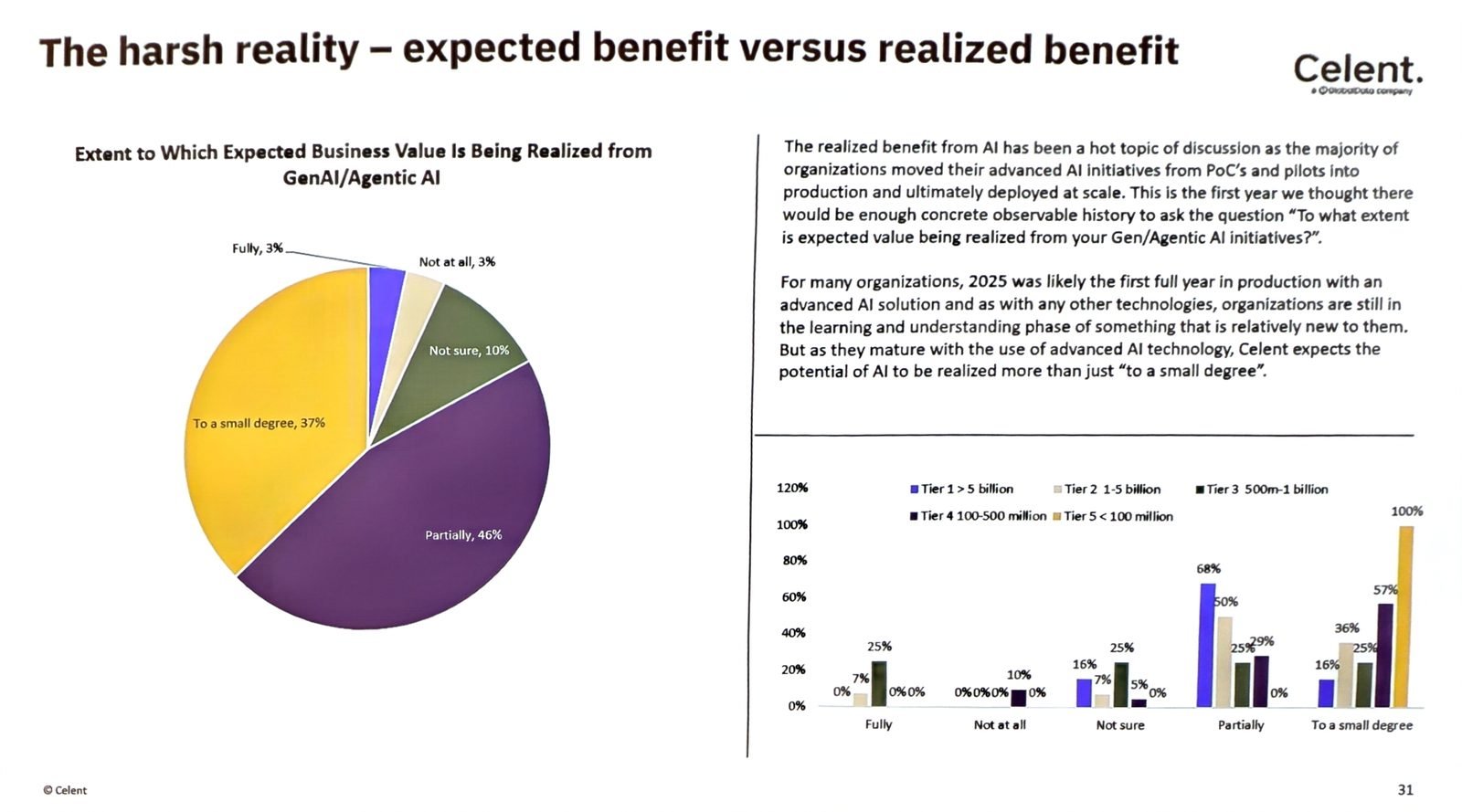
This was the first year Celent asked how much of the expected value insurers are actually getting. Raymond said he was not surprised by the answer. Only 3% said fully. Many firms move a pilot toward production and then stumble when they try to scale, because the foundations are not in place. A pilot is cheap. Running AI at scale is not. ROI now tops the list of concerns, with 42% of respondents calling it a significant concern, level with data privacy and just ahead of hallucinations and trust in output at 41%.
O’Donoghue picked up on the 3%. In his view, most firms are stuck because they do not have an operating model to take AI all the way to realized value. He also drew a clear line between the two kinds of AI:
Generative AI is about getting the words right. Agentic AI is about getting the actions right.
Sean O’Donoghue, as told to the room at ITC Vegas 2026 (paraphrased)
How should insurers measure the value of AI?
O’Donoghue said Security Benefit started by buying tools from several vendors. The team kept rebuilding the same rules and controls inside each one, without full access to the code. So it built its own orchestration platform, proved it with small wins such as knowledge assistants, and grew from there. Having one platform also makes measurement easier.
His method is simple: count. Find the tasks people repeat that they do not need to do, and count how many go away. One agent prepares sales meetings so salespeople do not have to. Another handles the same customer questions that come in again and again. Once the counting shows work is changing, a whole process can be redesigned. He prefers this to what he called a grand ROI case built on assumptions.
Shah said the clearest measure today is capacity. At CSAA, that freed capacity is mostly going into customer engagement and experience, not into cutting staff. Her second measure is reuse. The goal is not ten tools doing the same thing, but shared building blocks, such as document extraction, that serve claims and other lines alike.
What are the pillars of a sound AI strategy for insurers?
CSAA: five pillars
Business value before tools. A reuse architecture. Interoperability and optionality, so the company is not tied to any one tool or model. Governance by design, not added later. And change management, so employees are comfortable and know where to use AI.
Security Benefit: three pillars
An operating model, with an AI control team that covers ethics, solution design, build and run. A unified data platform, because without it, he said, you cannot personalize and are only guessing. And a platform with governance rules written in code, plus AI judges that check answer quality.
For annuities, O’Donoghue said, all the rules are in the contract. What the customer lacks is the answer before they act, for example on the tax impact or guaranteed income effect of a withdrawal. Security Benefit wants AI to close that gap as an experience layer around each transaction. The money itself is kept out of the model’s hands: code that always gives the same answer produces the monetary values, and the model handles the language.
When should insurers use automation, AI or agents?
Shah gave a simple test. If a task is deterministic and must work the same way every time, use automation. Bring in AI when there is ambiguity. Use agents when there is a sequence of actions that can branch. She also warned against plugging AI into old workflows as they stand. Some steps exist only because they always have. The bigger risk as agents start making decisions, she said, is that they work from stale or incorrect information, so documents must be understood, classified and routed correctly first.
O’Donoghue described the same balance. In a workflow, code decides the steps. In an agentic solution, the model decides what happens next. Many of Security Benefit’s solutions blend both. His team even used coding agents to build a reporting platform, while the reports themselves run as fixed, coded automation.
Why it matters for insurers
The survey says the technology is arriving. The panel said value depends on how the company runs it: a clear operating model, clean data and context, reuse, and people who are ready to work in a new way.
ZERO LEGACY, from Zero Legacy Press, makes the same case in Chapter IV, page 99: “The differentiator is not the model. It is the operating model.” The book points to research showing the highest performers spend roughly 70% of their effort on people, process and cultural change, and only 10% on the algorithms. O’Donoghue’s split between code and language also matches Chapter I, page 33, where the language model works only on language and is “forbidden from ever producing the priced number.”
Who spoke at the session
- Keith Raymond, Director, Celent (host)
- Sean O’Donoghue, Chief Digital, AI and Technology Officer, Security Benefit
- Pooja Shah, AI Product and Strategy Lead, CSAA Insurance Group