
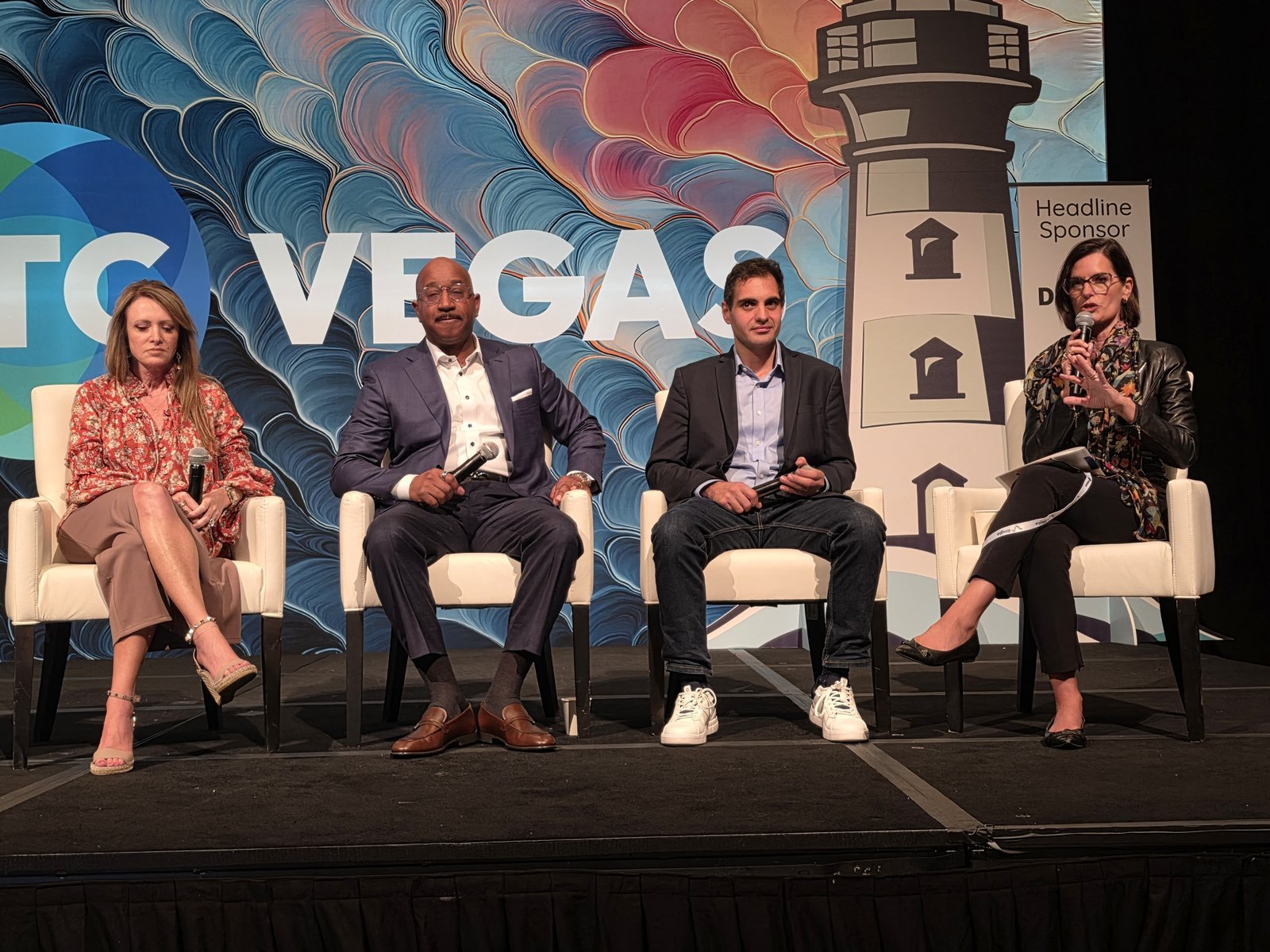
- Session
- The AI arms race: Who will win in the next era of insurance? The opportunity, risk and real-world impact of AI across insurance, presented by Shift Technology
- Stage
- Capacity Connect Summit, Mandalay Bay Ballroom K, ITC Vegas 2026, Las Vegas
- When
- Wednesday, September 30, 2026, 2:25 p.m.
- Speakers
- Jeremy Jawish, CEO and Co-Founder, Shift Technology; Alina Wilkinson, VP Claims Processes, Medical, WC, SIU and QI, Liberty Mutual; Cain Hayes, former President and CEO, Point32Health
Key takeaways
- Jeremy Jawish of Shift Technology said insurers are seeing “an enormous spike” in fraud attempts using AI: fake pictures, fake narratives and even fake testimony.
- Insurers still hold the edge in data. Cain Hayes said they can see patterns across millions of transactions and work together as an industry.
- Alina Wilkinson said Liberty Mutual is moving from reactive to proactive fraud work, and is testing AI agents loaded with its own standard operating procedures.
- Hayes’ rule for what to automate: it depends on the decision and the stakes for the customer, because “in insurance, we’re in the trust business.”
How is AI changing insurance fraud?
Jawish said fraud attempts using AI have jumped sharply across the claims chain. It has become so easy to create things that are not real but look real that anyone out to get extra money is now using it.
Hayes, who spent years in health insurance, said the same tools have made it easier for bad actors to create fake identities and fake documents, and even a video message asking for a wire transfer. But he said insurers are not starting from behind.
“We have lots of data. We can see patterns across millions of transactions, and we can collaborate within the industry. But certainly, it’s a bit of an arms race.”
Cain Hayes, former President and CEO, Point32Health
How is Liberty Mutual fighting AI-assisted fraud?
Wilkinson said the whole industry is moving from reactive investigation to proactive detection. At many carriers, claims and underwriting have worked as two separate worlds. The ones that win, she said, will connect them and build what she called “full perimeter fraud detection,” spotting risk as it comes in the door.
Liberty Mutual is now testing AI agents that carry its own standards of practice, so its investigators run full, consistent investigations and reach the right decisions. The aim is to get adjusters and investigators into the right files at the right time, while protecting the book in what she called a litigious world.
She also described a threat most carriers will recognize: a fraudster steals a real person’s identity, calls in a third-party claim in their name, and gets paid. Before anyone notices, a carrier can pay out hundreds of thousands of dollars to people who never held a policy. “I don’t know that there’s a secret sauce or a magic bullet,” she said. It is, in her words, a perpetual treadmill.
Why isn’t a shared fraud database enough?
The moderator asked why the industry does not track bad actors in one national database. Wilkinson said the problem with any database is that it works after the fact. Carriers and their vendor partners already share what they know, so most known bad actors are flagged. The hard cases are the new ones, who keep changing identities and methods.
“As a carrier with other carriers in the room, we have to work together on this,” she said.
How should insurers decide what AI to scale?
Hayes tests every AI project against four criteria. Does it make it easier for customers to do business with you? Does it lower claim cost or speed up processing? Does it improve speed and accuracy in operations? And does it give a competitive edge that is hard to copy? If a project meets all four, he said, go fast and invest big.
Since every insurer has access to the same AI tools, he said the winners will be the ones with the best data, the best operating model and the right people, with a real willingness to change. He also argued for more than one speed: move fast on experiments and learning, but be deliberate on high-stakes decisions that affect people’s health or finances.
“In insurance, we’re in the trust business.”
Cain Hayes, former President and CEO, Point32Health
A large insurer, he said, looks for three things before it trusts a new tool: it has to be real, it has to scale across millions of transactions rather than live as a pilot, and it has to be defensible.
How does Shift Technology keep up with new AI models?
Jawish said insurers are moving at very different speeds. Some go all in, while many, he said, simply freeze.
Inside Shift, the work has changed. Over the last three years, the team’s job has moved from building algorithms to benchmarking models, which it now does every week. Simple tasks go to cheaper models and the most complex ones go to the most capable, which keeps quality high and costs under control, with compliance controls on top. He summed up the job today as benchmarking, testing, training and complying.
He also said AI now lets technical teams do far more work, and Shift tracks team productivity month over month to make sure the extra output goes into work that actually matters.
Why it matters for insurers
Every gain in speed creates a new opening for fraud. As claims move faster and payments move instantly, the check at the front door has to move just as fast, and it has to be one that customers can trust.
ZERO LEGACY, from Zero Legacy Press, makes the same point in Chapter V. On page 148 it warns that an instant payment is an irreversible payment, so instant settlement is safe only when paired with real-time fraud scoring: “Speed on the payout rail must be matched by speed on the fraud rail, or the saving is handed straight to the fraudster.” Read about the book.
Who spoke at the session
- Jeremy Jawish, CEO and Co-Founder, Shift Technology
- Alina Wilkinson, VP Claims Processes, Medical, WC, SIU and QI, Liberty Mutual
- Cain Hayes, former President and CEO, Point32Health