
- Session
- Claims Agent Masterclass: How to Build an Agent You’d Trust with a Claim
- Stage
- Masterclass Series, Mandalay Bay Ballroom D, ITC Vegas 2026, Las Vegas
- When
- Wednesday, September 30, 2026, 11:00 a.m.
- Speaker
- Tom Deaney, Head of Applied AI for Insurance, Anthropic
Key takeaways
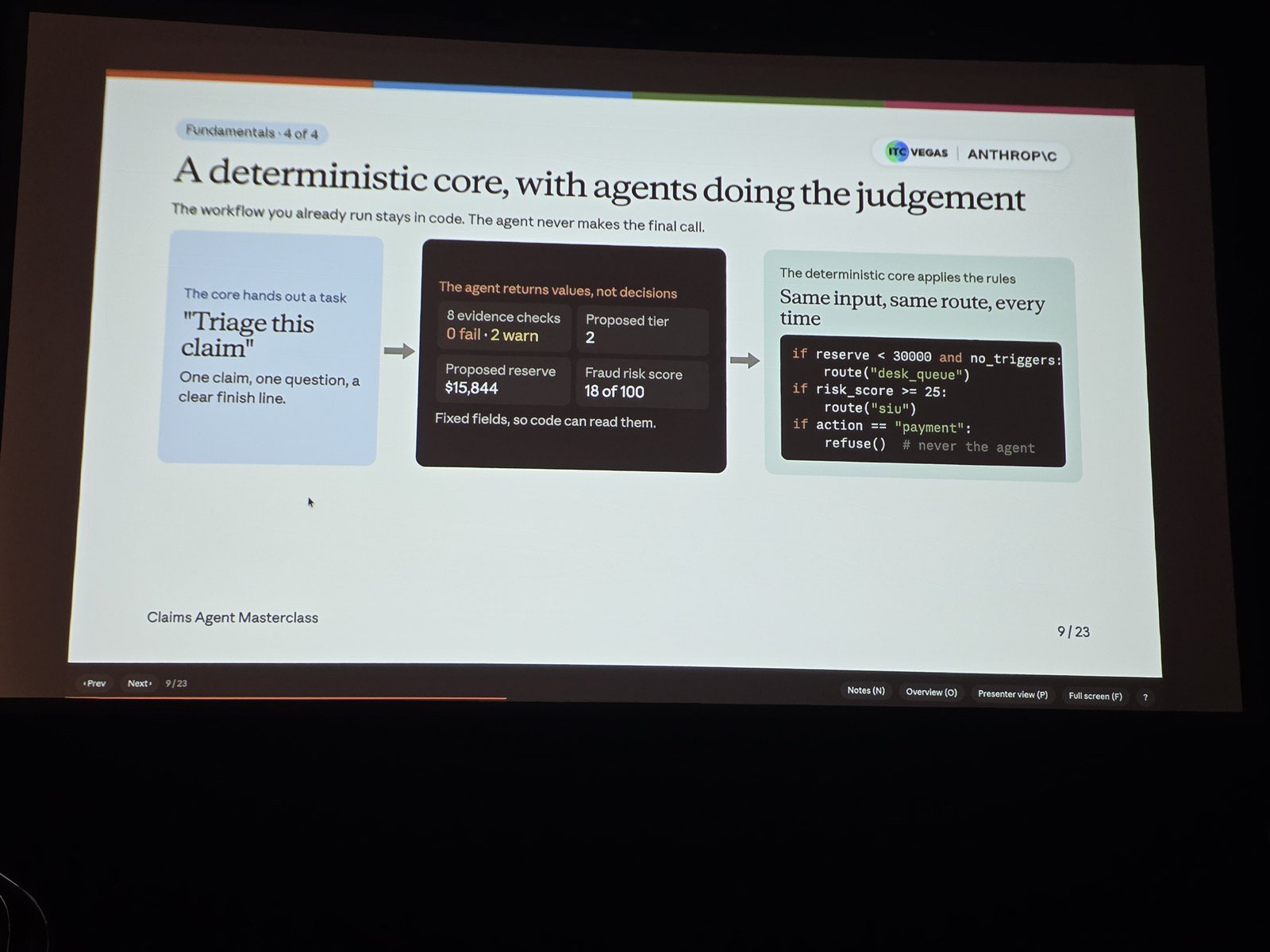
- The workflow a carrier already runs stays in code. The agent returns findings, never decisions. On the slide, a payment request is refused by a line marked “never the agent.”
- An agent is configuration, not code: a model, a short set of instructions, tools that reach the core system, and the claims handbook it follows.
- Trust is earned step by step and proven on cases your own experts agree on, “not by a date.”
- A large US carrier used the same pattern on coverage and had an agent working in shadow mode on real claims within 12 weeks.
What should a claims AI agent be allowed to decide?
Deaney started with where AI stands today. He said first notice of loss is now close to something a single agent can handle with the right context. Fraud, special investigations and coverage sit at the edge of what models can do, and that is where a carrier’s own experts and data make the difference. Complex claims litigation, he told the room, is not ready yet.
Then he set out three questions every claims leader should ask before building anything. What does the agent need to know? How do you know it is working? Who is responsible at each stage?
His answer to the last question shaped the whole hour. The core system hands the agent one clear task, such as “triage this claim.” The agent comes back with findings that code can read. Then the carrier’s own rules make the call. Same input, same route, every time. He said that is what lets a carrier show a regulator, with certainty, that the same facts always lead to the same outcome, and it keeps a planted line in an uploaded document from ever steering a final decision.
“The workflow you already run stays in code. The agent never makes the final call.”
Slide from Tom Deaney’s Claims Agent Masterclass, Anthropic
What is an agent, in plain terms?
Deaney defined an agent as a loop that thinks and tools that act. Where each part lives, he said, is the difference that matters. When everything sits in one box, it all starts, scales and fails together.
His answer was to keep the brain and the hands apart, with a full record of every step kept outside both. One line from that slide will stay with security teams: “No secret ever reaches the brain.”
What did the live build show?
Deaney built the agent live in four steps: build it, give it the carrier’s rules, measure it, and put it to work. Each step was a single prompt.
The first version ran and was not good yet, which was the point. On a water claim it still caught a $2,100 line on the contractor’s estimate for replacing cabinets that were not damaged. Once it had the carrier’s own handbook, every finding came back with the section it came from. After measuring and improving, it passed every test case, including the ones nobody had tuned it against.
The fix that closed the last gap was very human. A hail claim looked covered at the desk. The agent had never looked up the roof’s age. It was 25 years old.
“One claim is an anecdote. Measure it.”
Slide from Tom Deaney’s Claims Agent Masterclass, Anthropic
How is trust in a claims agent earned?
Deaney laid out five steps from the first test case to production: train, test, shadow, draft and bounded autonomy. For the first three, people stay fully responsible while the evidence builds. After that, the agent takes on routine work one step at a time, and only when the results say it is ready, “not by a date.”
Even at the last step, adjusters keep the hard claims and keep checking the rest.
Asked how many agents a carrier should build, his answer was simple: draw the line around the data. An agent that talks to customers should never be able to reach underwriting files, so those are separate agents.
“Agents should only go as far as the data they can touch.”
Tom Deaney, Head of Applied AI for Insurance, Anthropic
Has this worked at a real carrier?
Deaney showed the same pattern at a large US carrier, which he did not name, applied to coverage. They started with one decision and one flow. Within 12 weeks the agent was running in shadow mode on real claims, read only, with its coverage position compared field by field against the one a person reached. Hundreds of test cases came from the carrier’s own claim files, and thousands of expert comments fed back into the agent.
“We’re already seeing the agent outperform adjusters on this dataset.”
Tom Deaney on the carrier’s coverage agent, 12 weeks in
He was clear about where the effort goes. Most of it is up front, with the carrier’s experts, working out what the agent gets wrong. Get the test cases right, he said, and that is probably 70% of the work of building an agent already done.
He closed with three moves any carrier can start now. None of them lock you into a vendor, and each takes longer than building the agent itself.
What does an agent you’d trust with a claim look like?
Deaney’s last slide boiled the hour down to three tests:
- Accuracy: proven against how the business has really been run.
- Safety and governance: it works in a trusted setting, with only the tools it needs.
- Auditability: you can understand every decision that was made.
Why it matters for insurers
Most AI claims talk this year has been about what agents can do. Deaney’s masterclass was about where they must stop, and how a carrier proves it. Keeping the decision in tested, rule-based code is what lets a carrier explain every outcome to a policyholder, an auditor or a regulator.
ZERO LEGACY, from Zero Legacy Press, draws on Anthropic’s own thinking. In Chapter I, The Great Decoupling, it quotes Mike Ram, Head of Insurance at Anthropic: “the model is the brain, the harness is the body.” Deaney’s slide on keeping the brain and the hands apart is that idea, built live.
The book makes the same case about decisions in Chapter II. On page 43 it argues that “deterministic math is not an engineering preference; for a regulated number, it is a legal requirement.” On page 44 it quotes Arron Lamp, CIO of Tokio Marine Public Risk, who told carriers to “treat AI as a microservice, not an agent.” Chapter IV, The Accountability Layer, covers what happens when that line is crossed. Read about the book.
Who spoke at the session
- Tom Deaney, Head of Applied AI for Insurance, Anthropic