
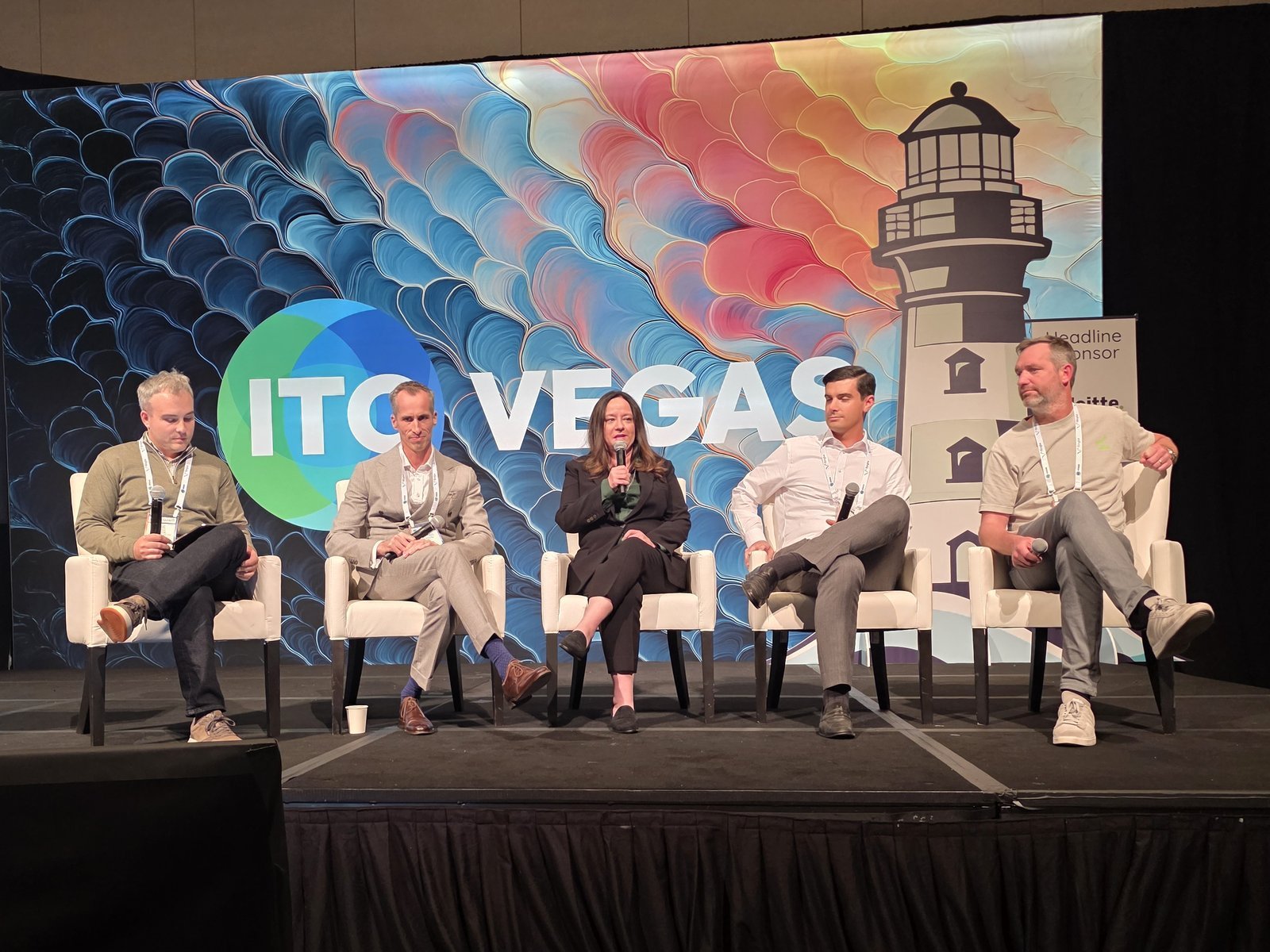
- Session
- Capital meets capacity: The live market
- Stage
- Capacity Connect Summit, Mandalay Bay Ballroom K, ITC Vegas 2026, Las Vegas
- When
- Wednesday, September 30, 2026, 2:50 p.m.
- Speakers
- Mike Mansell, Principal, American Family Ventures (moderator); Thomas Galbraith, CEO, Barkr; Elena Herrick, VP, Product and Underwriting, Munich Re Specialty; Dante La Ruffa, Partner, Co-Head of Venture and Growth, Aquiline Capital Partners; Alexander Niehenke, Partner, Scale Venture Partners
Key takeaways
- Elena Herrick said Munich Re Specialty wants MGAs that use AI and data heavily and see their portfolio in real time, because “technology by itself is no longer a differentiator.”
- The market has shifted from growth and technology to profitability and insurance expertise.
- AI makes it easier to launch an MGA, the panel agreed, but not easier to run a good one. Thomas Galbraith of Barkr said AI “can’t magic revenue out of thin air.”
- Asked how many MGAs he had backed in the past 12 months, Alexander Niehenke of Scale Venture Partners said: zero.
What surprised the market in the last few years?
Herrick said she expected fully AI-driven MGAs by now. Instead, AI has turned out to be an enabler, not a replacement for the basics. Earlier this year her team tested an AI-enabled underwriting workflow on an MGA’s platform, written on Munich Re paper. The lesson: you still need underwriting guidelines, guardrails, operational controls and continuous monitoring to make sure outcomes match expectations.
Dante La Ruffa of Aquiline, at his tenth ITC, said he expected a few bad seasons to scare capital away from MGAs. Instead, interest has come back strongly over the last three years, with the market now looking at MGAs mostly through a specialty lens. Generalist investors like the sector, he said, because it is large, runs on old technology that AI can modernize, and the MGA is an easy distribution model to understand.
Niehenke was surprised that some founders still pitch the MGA model as a way to keep risk off their balance sheet. The risk, he warned, always comes back.
Galbraith said AI has moved faster than insurance. Some policies now exclude AI because carriers are still learning how to underwrite it. His company, Barkr, uses AI to value hard assets for lenders and can guarantee those values. The turning point came when it met Munich Re’s AI insurance team, who already saw that AI risk can be understood and underwritten.
What does a capacity provider look for in an MGA?
Herrick was direct. Munich Re Specialty is looking to back MGAs that use AI, lean heavily on data and have real-time insight into their portfolio. It is not looking for technology companies that want to experiment with insurance.
“Technology is still very important, but technology by itself is no longer a differentiator in this space.”
Elena Herrick, VP, Product and Underwriting, Munich Re Specialty
She also sees a wave of experienced underwriters leaving carriers and reinsurers to start or join MGAs, especially in AI. Her advice to new MGAs: bring in people with long industry experience, because that history is what earns a capacity provider’s trust.
What do venture investors want from MGA founders?
Niehenke said a founder who treats the MGA as a way to avoid risk is an alarm signal. He wants a strong view on how the company will find a different customer or price risk differently, with the MGA as the fastest route to market. The best founders also plan how to add capacity over time, because a company with one capacity partner depends on it completely.
La Ruffa looks for a unique underwriting model, ideally with a track record, and data that keeps getting more valuable to the carrier over time. With a lot of capacity on the sidelines, many similar MGAs are launching into the same markets. He expects many of them to merge over time.
Niehenke went further. In practice, he said, the only MGAs he would back have a real edge in distribution or new pricing data that lets them see risk others cannot. The incumbents, he added, are very good at distribution.
Does AI create better MGAs or just more of them?
Both, the panel agreed, but more does not mean better. La Ruffa said it is now easy to build features over a weekend, but AI does not fix a weak business model. Efficiency alone is not enough; an MGA has to use its data to keep adding value for the carrier.
Herrick said AI will improve underwriting for reinsurers and carriers while lowering the barrier to launch. The MGAs that win will be those that use AI to bring carrier-level underwriting discipline.
Galbraith put it simply: a terrible idea launched faster is still a terrible idea. An MGA has to be a good steward of its risk, he said, because in the end it is still your risk. Carriers stay with MGAs that manage risk well. La Ruffa added that even the best AI-powered MGA goes nowhere without capacity, and without respect for the work of keeping it.
Does an MGA need venture capital?
Galbraith’s advice to founders was not to let perfect get in the way of good. Barkr launched with a capacity contract that was good enough, then used real data from the market to improve it and grow. He funded the company himself for its first two years, until it had product-market fit and revenue.
“Raising venture is great, but it’s a little bit like a sugar high.”
Thomas Galbraith, CEO, Barkr
Revenue, he said, is the protein. La Ruffa agreed that raising money for its own sake makes little sense, but noted the value of a strategic partner that speeds up go-to-market.
Why it matters for insurers
The message to MGA founders was clear. AI will help you launch, but capacity goes to MGAs that can prove underwriting discipline, show their data and manage risk as if it were their own balance sheet.
ZERO LEGACY, from Zero Legacy Press, covers the same ground. On pages 97 and 110, it traces Munich Re’s aiSure, launched as the industry’s first dedicated AI performance cover. It is the same idea Galbraith described: AI risk can be understood and underwritten. And its Capstone Thesis tells MGAs that a documented record of every decision is “the proof of discipline that expands your authority.” Read about the book.
Who spoke at the session
- Mike Mansell, Principal, American Family Ventures (moderator)
- Thomas Galbraith, CEO and Co-Founder, Barkr
- Elena Herrick, VP, Product and Underwriting, Munich Re Specialty
- Dante La Ruffa, Partner, Co-Head of Venture and Growth, Aquiline Capital Partners
- Alexander Niehenke, Partner, Scale Venture Partners